Geography 2050

Geography 2050 is a multi-year, strategic dialog about the vital trends reshaping the geography of our planet in the coming decades. Initially organized by the American Geographical Society (AGS) in 2014, the ongoing Geography 2050 dialogue convenes thought leaders from academia, government, industry, and the social sector to facilitate discussion of the major forces that will shape our planet’s future. In the late 20th century, talk of a borderless world began to take hold among many in both academia and the media as the end of the Cold War and the forces of globalization rapidly impacted the planet. While many aspects of globalization led to greater fluidity across international borders in terms of trade, capital, technology transfer, and the movement of people, this same period witnessed the creation of more international borders, not fewer. This symposium questions what the world map will look like in 2050 and how our practice of defining, maintaining, and even understanding the meaning of borders might change. Within each theme, we will look both at scenarios of increasing interdependence and division and how they could play out by 2050.

This year’s Symposium will focus on how geography and geospatial science impact the role of borders in our future economy, environment, and geopolitical situation.  Click below for more info.

geography2050

Charging for Landsat Data?

Landsat data has been free and open since 2008.  In 2017 there was a request from the Department of the Interior that the USGS consider the possibility of fee recovery for Landsat data.  The Landsat Advisory Committee (LAG) took up the task to review it.  Their analysis focused on three cost-sharing approaches: charging for traditional data, charging for value added products and services, and private-public partnership (P3) structures.

The LAG has finally released their findings in a report, “Evaluation of a Range of Landsat Data Cost Sharing Models”.  Spoiler alert: the committee did not recommend charging for Landsat 8 and 9 data stating, “The LAG believes that charging a fee for Landsat data will generate little net revenue.”  They note that doing so would “result in negative economic impacts to the U.S. commercial remote sensing satellite and value-added industries.” Laws and regulations would need to be changed in order charge for data and that the revenue gained would not be worth the economic, legal, societal or political costs.

For more info and to view the report click here.

The Last Commercial Orange Grove

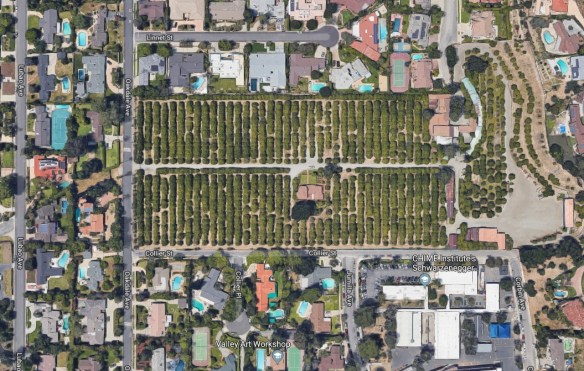
Back in the 1920’s agriculture played a dominant role in the San Fernando Valley region.  At one point 75,000 acres of Valley land between towns and subdivisions was used for farming, which included 750,000 citrus trees.

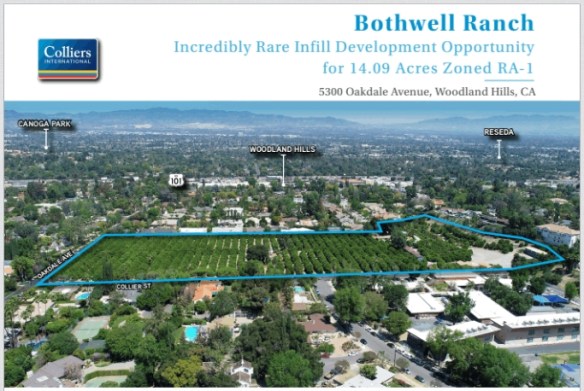
By the 1990’s the Valley’s working citrus industry dwindled to just one, the Bothwell Ranch.  It is located in Tarzana at the corner of Oakdale Ave and Collier St, just a half mile south of Ventura Blvd.

orangegrove1

Now it is up for sale.  The asking price is $13.9 million.  Collier International and Coldwell Banker is billing the property as “an incredibly rare infill development opportunity”.  Marketing materials include a site plan that would split the 14 acres into 26 half acre lots for development into 2-4 million dollar single family homes.  How sad.  Click below to read the article about it.

orangegrove2

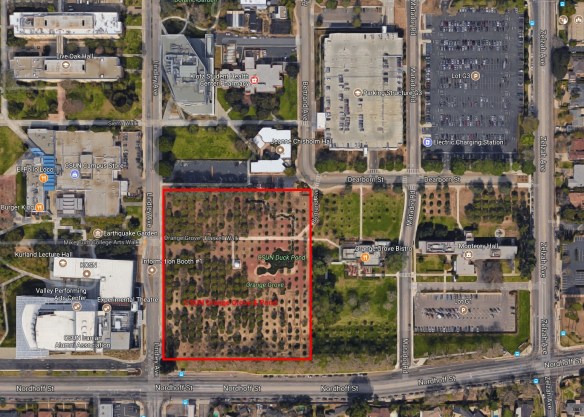
The good news is that not too far away is the last historic orange grove of San Fernando Valley owned and protected by CSUN.  The area includes 400 orange trees, a pond, bistro, and observatory.  The orange grove has thousands of fresh, free oranges waiting to be picked by you!  Anyone from anywhere can pick oranges at any time from the orange grove.  Have fun, and make sure to feed the red-eared slider turtles in the pond too!

orangegrove3

Fireworks 2019!

July 4th is just around the corner, which means there will be fireworks again!

Use the app to view cities in LA, Orange, Ventura, Riverside, and San Bernardino County that allow the sale and discharge of fireworks.  Included are days and times when fireworks will be sold and when you can light them up, as well as links to city websites and telephone numbers.  Data was collected from municipal codes, websites, and/or contacting each city.  Some cities allow sales to start today AND allow you to discharge them today as well!  Check it out!

fireworks2019

Spatial@UCSB This Thursday

Just a reminder that Spatial@UCSB will be happening this Thursday, June 6.  This year’s theme is Spatial Data for Smarter Cities.

Where: Corwin Pavilion, UCSB – 494 UCEN Rd, Isla Vista, CA
When: Thursday June 6th, 11:00 to 2:30 pm

Agenda:

11:00 Plenary Session:

  • Kurt Shellhause (Kasraie Consulting, CIRGIS) – Think Inside the Box, Outside the Box, and about what could Destroy our Box
  • Mahnoosh Alizadeh (Electrical and Computer Engineering, UCSB) –
    Opportunities and Challenges of Transportation Elecrication in Smart Cities
  • Konstadinos Goulias (Dept. of Geography, UCSB) – Activity-Travel GeoSimulation for Smart City Planning, Design, and Operations
  • Werner Kuhn (Dept. of Geography, UCSB) – Moderator

12:30 – 2:30 Lunch and Poster Exhibit

Registration has been extended to the end of Tuesday, June 4th. Please contact Karen to RSVP: kdoehner@spatial.ucsb.edu or (805) 893-8224.

GIS Management Practices Survey

Dear GIS Colleagues,

We are contacting you to request that you participate in a survey on GIS management practices.  This survey is sponsored by URISA’s GIS Management Institute (GMI).  The purpose of the survey is to analyze current GIS program and project management practices, in order to gain insights and assess current trends.

All respondents will be provided with a report summarizing the survey findings.  In the future, URISA and GMI will make more detailed data available for purchase.  In addition, Peter Croswell of Croswell-Shulte will access the data.  He will use some of the data to revise his GIS Management Handbook, available for purchase later this year, and 30 respondents will be selected at random to receive a free copy of the book.  No personally identifying information will be released, except as authorized by question 26 in the survey.

The appropriate respondents to this survey are GIS program and project managers in all types of organizations. Please feel free to encourage your GIS manager colleagues in other organizations to take the survey.  We appreciate your time for response to this survey.  The survey has 26 questions and should take approximately 25-35 minutes to complete.

Survey Link:     https://www.surveymonkey.com/r/GMI-Survey

We request responses by May 31, 2019.

If you have any questions, please contact GMI at GMIsurvey@urisa.org

Thank you for your participation.

GIS Management Institute