ESRI released ArcGIS Pro 2.5 last week. You can download it from your ESRI account on my.esri.com.
Visit the ESRI blog about what’s new and watch the video below showing the new features in ArcGIS Pro 2.5.

ESRI released ArcGIS Pro 2.5 last week. You can download it from your ESRI account on my.esri.com.
Visit the ESRI blog about what’s new and watch the video below showing the new features in ArcGIS Pro 2.5.
On December 31, 2019, the World Health Organization (WHO) was informed of an outbreak of “pneumonia of unknown cause” detected in Wuhan City, Hubei Province, China – the seventh-largest city in China with 11 million residents. By January 23, there was over 800 cases of 2019-nCoV confirmed globally, including cases in at least 20 regions in China and nine countries/territories. As of this writing, there are now 17,485 confirmed cases and 362 deaths!
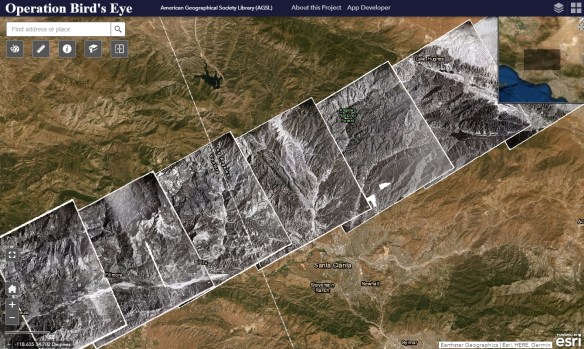
Operation Bird’s Eye is a photographic collection of nearly 400 overlapping aerial images which form a continuous strip spanning the United States from coast to coast. Beginning in Ventura, California and ending over Long Island, New York, these nine by nine inch prints capture a sliver of the American landscape as it looked in 1948. The images were captured during one continuous flight, and when joined together the physical prints stretch 192 feet, showing a slice of land 2,700 miles long.
The flight from which these images were captured took off from the Air Force Flight Test Center (now Edwards Air Force Base) in Muroc, California at 7:40 AM local time on September 1, 1948, first gaining altitude out over the Pacific Ocean before turning east. The plane was a Republic XR-12, an experimental aircraft of which only two were ever built. It was outfitted with K-17 cameras able to shoot a continuous roll of film up to 200 frames. The camera shot at 50 second intervals throughout the duration of the flight, at a constant altitude of 40,000 feet, resulting in a field of vision of around 130 square miles.
The purpose of the XR-12 was photo reconnaissance, and Operation Bird’s Eye was meant as a demonstration of its capabilities. The plane, able to fly high and fast enough to avoid conventional enemy aircraft and fighters, was essentially a flying photography laboratory, with the crew able to process film mid-flight. The Operation Bird’s Eye flight broke records as it crossed the continent, capturing the longest span of aerial photos ever accumulated in a single trip to that point. After 6 hours and 55 minutes, the crew landed at Mitchel Field in Garden City, New York on Long Island.
Click below to read more and check out the images!
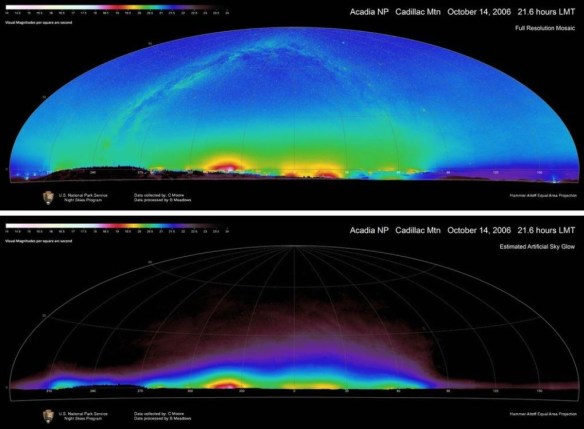
Check out this article about mapping resources that we do not see or hear, like natural sounds, dark night skies, and clean air. Click below to read.
Teachers of a variety of subjects and grade levels who would like to incorporate maps into their classroom activities may want to check out ESRI’s GeoInquiries, a collection of short, standards-based inquiry activities for teaching map-based content found in commonly used textbooks. You will find a library of activities organized by topic, with each topic containing 15-20 different activities. Each GeoInquiry activity includes a teachers’ guide in PDF format, an interactive webmap, and an optional worksheet for students. Most activities are Level 1, which are “activities that teach standards-based content without a login to or installation of ArcGIS Online.” Some topics also offer Level 2 activities that use ArcGIS Online analysis tools. Those new to using GeoInquiries should be sure to read through the guide Getting to Know GeoInquiries, which is linked in the introductory paragraph on the collection’s main page. Check it out!

Over eighty years after it was originally published, Charles O. Paullin’s Atlas of the Historical Geography of the United States remains one of the most impressive and most useful atlases of American history. Containing nearly 700 individual maps spread across 166 plates, it addresses a broad range of issues. Beginning with a chapter consisting of 33 maps on the natural environment and a second containing 47 maps documenting the evolution of European and later American cartographic knowledge about North America, the atlas mapped an exhaustive number of historical topics: exploration and settlement of the continent, the location of colleges and churches, disputes over international and state boundaries, voting in presidential elections and in Congress, reforms from women’s suffrage to workmen’s compensation, transportation, industries, agriculture, commerce, the distribution of wealth, and military history. Continue reading
Geographic masking is a technique used to basically move your data around so not to give away the exact geographic coordinates of individual level data. This is done when locations of individuals (like in health data, crime data, or endangered species data) need to be “anonymized” so they cannot be re-identified through reverse geocoding.
One tool that does this is MaskMy.XYZ. MaskMy.XYZ helps users perform a time-tested geographic mask from the scientific literature, known as donut masking. Instead of being a toolbox for a specific (potentially expensive) GIS software suite, MaskMy.XYZ uses popular open source JavaScript libraries to mask data without ever requiring users to install or download any software. So whether you’re a GIS expert who can’t be bothered to script this method yourself, or a GIS newbie who knows you need to mask your data but aren’t quite sure how, MaskMy.XYZ makes your life easier and brings previously cumbersome methods into reach.
Everything runs client-side in your browser, meaning there’s nothing to install, data never leaves your computer, and as a result nobody except you ever sees your confidential files. It is a safe and secure way to anonymize spatial data. Finally, you can map your secret fishing spots and share them with others without giving away the exact locations! Check it out!

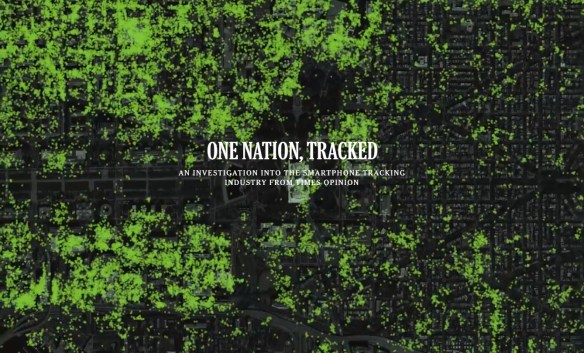
Here is a scary report from New York Times on how our personal locations are being tracked, and mostly from unregulated location data companies that cross reference your location with other databases to figure out who you are, where you live, and where you have been.
“In one case, we observed a change in the regular movements of a Microsoft engineer. He made a visit one Tuesday afternoon to the main Seattle campus of a Microsoft competitor, Amazon. The following month, he started a new job at Amazon. It took minutes to identify him as Ben Broili, a manager now for Amazon Prime Air, a drone delivery service.”
Click below to read the report, and parts 2 to 7!
Check out this article on how to add historical USGS Topo maps to your web map in ArcGIS Online. It’s pretty easy to do!

ESRI announced that it has partnered with 3DR, a leading US drone data company, to expand ESRI’s current drone imagery offering, Drone2Map for ArcGIS, with an end-to-end enterprise drone data and analytics solution for ESRI’s ArcGIS platform. Click below to read more.


