US Interagency Elevation Inventory

Dear colleagues,

The USGS National Geospatial Program is again updating the US Interagency Elevation Inventory. We invite you to provide us information so that your data is discoverable by others. Your data need not be in the public domain, and the entry will provide a link to inquire about the data, or to a download site if available. This is not a repository for data; it is a way to make data findable. If you have high quality lidar data you wish to donate to USGS data repositories, we can have the conversation at any time.

https://www.coast.noaa.gov/inventory/

If you wish to make your data discoverable through the inventory, we will need the following:
  • Shapefile footprint with metadata
  • Vendor tasking, if available
  • Status (in work, available, etc.)
  • Restrictions (if it is public domain)
  • QA or acceptance reports (so we can calculate quality level)
  • Contact information (for internal purposes only; no PII will be publicly posted)
  • url for download or public inquiry (if available)
Due dates are as follows:
  • Arizona (to Drew by COB 3/25/2019)
  • Nevada (to Carol by COB 3/11/2019)
  • Hawaii (to Drew or Carol by COB 3/25/2019)
  • Pacific Basin Islands (to Drew by COB 3/25/2019
  • California (to Drew or Carol by COB 3/25/2019)

If you have an awareness of data that you did not procure, we are happy to chase down the source if you can provide a pointer to a contact person. We try to duplicate what currently shows in both NOAA’s digital coast and Opentopography.org. If you have updates to an existing entry on the inventory, please let us know by the due dates above.

Any questions, please call either one of us, and feel free to pass this request along to others inside or outside of your organization so that our inventory can be as up-to-date as possible.

Sincerely,

Carol and Drew

Drew Decker
National Map Liaison
U.S. Geological Survey
4165 Spruance Road
San Diego, CA 92101
619-225-6430
619-417-2879 cell
ddecker@usgs.go

Carol Ostergren
US Geological Survey National Geospatial Program
2885 Mission Street
Santa Cruz, CA 95060
831.460.7539 (office)

Geospatial Historian

The Geospatial Historian is “a tutorial-based open access textbook for historical scholars and digital humanists designed to teach practical digital mapping and GIS skills that are immediately useful to real research needs.” Under Lessons, you will find two series of GIS tutorials geared towards historical analysis and applications. The first series, which uses open-source software, is comprised of four lessons that the project team created for the Programming Historian. The second series contains five lessons that teach mapping, georeferencing, and other applications using ArcGIS. The site also offers a helpful list of resources for Finding Spatial Data, organized by data type and featuring data from around the world. Check it out!

gishistorian

OpenTopography

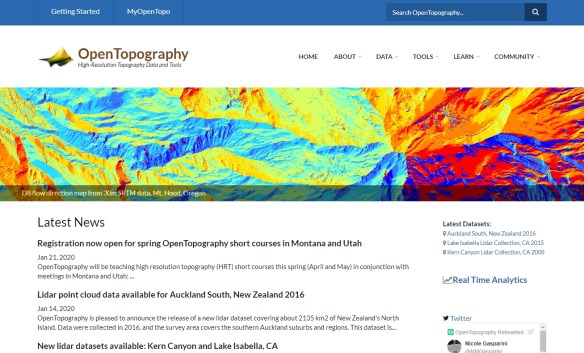
OpenTopography provides high-quality geographic data relating to earth science as well as a platform for researchers to share their own data. Based at the University of California, San Diego, OpenTopography is an ambitious project that “facilitates community access to high-resolution, Earth science-oriented, topography data, and related tools and resources,” and is funded through the National Science Foundation.

You can search or browse the project’s datasets via an interactive data map and a data catalog, both found under Data. Most of these datasets are available in Lidar point cloud format, and many are also available in other formats, such as raster or Google Earth.  Check it out!

opentopography

California Releases Interactive Public Geoportal

California has adopted a massive, interactive online database of location-based government data that includes over 1200 publicly available data sets from 25 state entities.

The California State Geoportal collects geospatial data from government agencies including housing, water, transportation and health information. The data is compatible with geolocation software and is designed to be shared, layered onto maps and analyzed.

The portal was designed by ESRI.  Check it out!

calgeoportal

Mapping 2019-nCoV

On December 31, 2019, the World Health Organization (WHO) was informed of an outbreak of “pneumonia of unknown cause” detected in Wuhan City, Hubei Province, China – the seventh-largest city in China with 11 million residents. By January 23, there was over 800 cases of 2019-nCoV confirmed globally, including cases in at least 20 regions in China and nine countries/territories.  As of this writing, there are now 17,485 confirmed cases and 362 deaths!

Continue reading

Operation Bird’s Eye

Operation Bird’s Eye is a photographic collection of nearly 400 overlapping aerial images which form a continuous strip spanning the United States from coast to coast. Beginning in Ventura, California and ending over Long Island, New York, these nine by nine inch prints capture a sliver of the American landscape as it looked in 1948. The images were captured during one continuous flight, and when joined together the physical prints stretch 192 feet, showing a slice of land 2,700 miles long.

The flight from which these images were captured took off from the Air Force Flight Test Center (now Edwards Air Force Base) in Muroc, California at 7:40 AM local time on September 1, 1948, first gaining altitude out over the Pacific Ocean before turning east. The plane was a Republic XR-12, an experimental aircraft of which only two were ever built. It was outfitted with K-17 cameras able to shoot a continuous roll of film up to 200 frames. The camera shot at 50 second intervals throughout the duration of the flight, at a constant altitude of 40,000 feet, resulting in a field of vision of around 130 square miles.

The purpose of the XR-12 was photo reconnaissance, and Operation Bird’s Eye was meant as a demonstration of its capabilities. The plane, able to fly high and fast enough to avoid conventional enemy aircraft and fighters, was essentially a flying photography laboratory, with the crew able to process film mid-flight. The Operation Bird’s Eye flight broke records as it crossed the continent, capturing the longest span of aerial photos ever accumulated in a single trip to that point. After 6 hours and 55 minutes, the crew landed at Mitchel Field in Garden City, New York on Long Island.

Click below to read more and check out the images!

operationbirdseye

GeoInquiries

Teachers of a variety of subjects and grade levels who would like to incorporate maps into their classroom activities may want to check out ESRI’s GeoInquiries, a collection of short, standards-based inquiry activities for teaching map-based content found in commonly used textbooks. You will find a library of activities organized by topic, with each topic containing 15-20 different activities. Each GeoInquiry activity includes a teachers’ guide in PDF format, an interactive webmap, and an optional worksheet for students. Most activities are Level 1, which are “activities that teach standards-based content without a login to or installation of ArcGIS Online.” Some topics also offer Level 2 activities that use ArcGIS Online analysis tools. Those new to using GeoInquiries should be sure to read through the guide Getting to Know GeoInquiries, which is linked in the introductory paragraph on the collection’s main page. Check it out!

geoinquiries