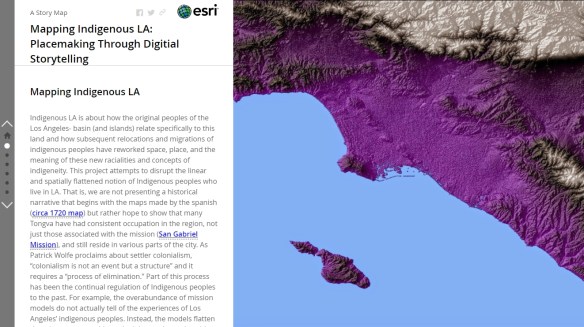
The Mapping Indigenous Los Angeles project from the University of California Los Angeles is creating a series of story maps that bring together a variety of stakeholders to help highlight “multiple layers” of diversity and identity. At the heart of the site are the story maps themselves, which unfold to reveal the complex history of place and the Indigenous peoples who have helped shape and been shaped by them. The story maps vary in length and depth, but all feature a variety of text, photos, podcasts, and other materials that help viewers immerse themselves in the subject matter and deepen their understanding. Check it out!
Author Archives: socalgovgis - Michael Carson
GIS Day Next Week
GIS Day 2019 is almost upon us. If you have an event and want to get the word out, send an announcement request through the About page and I will get it posted right away.
Here is one for the City of Irvine. They are celebrating GIS Day on November 14.
The big one at LA County will happen on November 13.
GIS Day will be celebrated at a number of colleges like: Pierce College, CSUN, and USC.
Channel Islands Regional GIS Collaborative (CIRGIS) will have GIS Day on December 6 at Ventura College. The keynote speaker will be Michael Goodchild.
Also make sure to register your event on the GIS Day website.
Add Google Maps to QGIS 3
If you use QGIS version 3, you have the ability to add Google Maps layers to your map. The Google Maps layers are really Tile Map Services (TMS). The following is an example showing how to add Google Maps to QGIS.
98 Map Projections
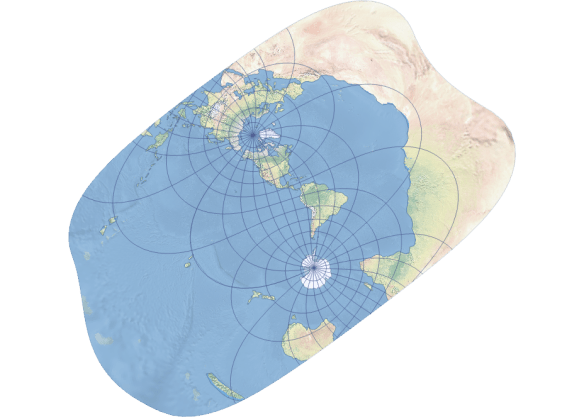
If you work with GIS in a local government, you usually do not get to try out some of those more interesting map projections. If you deal with world data, then you might get to use them. Like this one, the Rectified Skew Orthomorphic:

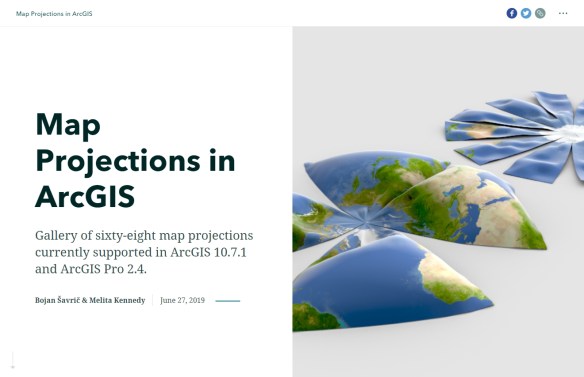
With ArcGIS 10.7.1 and ArcGIS Pro 2.4, you have access to 68 unique map projection algorithms and another 30 variations, 98 in total! Check out this story map showing a gallery of the 68 supported map projections, from Aitoff to Winkel Tripel.
Two New NASA ARSET Training Webinars
CGIA has posted that there are two new NASA ARSET training webinars that you can attend if you are interested. One is “New Sensor Highlight: ECOSTRESS” and the other is “SAR for Disasters and Hydrological Applications”. Visit the CGIA website for more information about these webinars.
GIS Conferences 2019/2020
Just a reminder that the ESRI Ocean and Atmospheric GIS Forum will be starting tomorrow.
In February and March 2020, you can enjoy the CalGIS conference, Geodesign Summit, and ESRI Developer Summit. Check out all conferences from the GIS/Mapping Conferences page.
The Large and Goodly Island of California
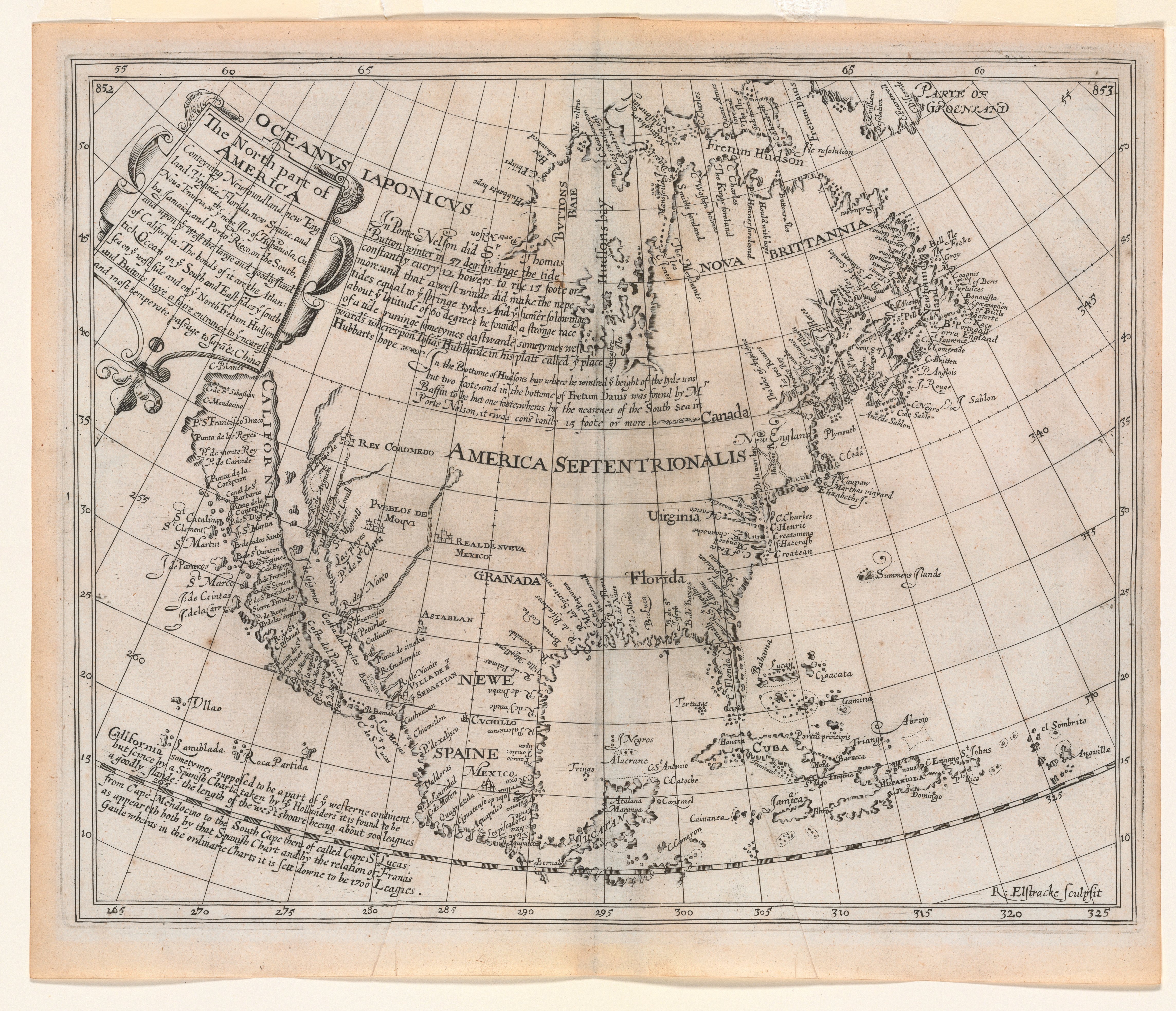
This 1625 map by British mathematician Henry Briggs initiated one of the most famous of all cartographic misconceptions, California as an island, which persisted until the end of the 17th century. This idea is thought to have originated with the Carmelite friar, Antonio de la Ascension who accompanied Sebastian Vizcaino on his West Coast expedition of 1602-03, and wrote an account of the trip. About 1620, it is believed that Father Ascension drew a map depicting California as an island and dispatched it by ship to Spain. The ship was captured by the Dutch and the chart taken to Amsterdam.
In 1622, California appeared as an island on two title page vignettes published in Amsterdam by Michiel Colijon: Jacob le Maire’s Spieghel Der Australische Navigatie and Antonio de Herrera’s Descriptio Indw Occidentalis. That same year in London, Henry Briggs published an article entitled “A treatise of the Northwest Passage to the South Sea, through the Continent of Virginia, and by Fretum Hudson.” Briggs claimed to have seen a map in London brought from Holland showing California as an island. His article was republished slightly modified in 1625 in Purchas’ Pilgrimes, and was accompanied by this map supposedly drawn from the one “taken by Hollanders.” A similar map engraved by Abraham Goos was inserted into a small book published in 1624 in Amsterdam. Although dated earlier, it is likely that this map used the Briggs map as a source.
Briggs’ map quickly became a model for others. John Speed copied it in 1626-7 as did Joannes Jansson in 1638, and soon nearly all European cartographers depicted California as an island. One purpose of the map was to suggest the probability of a short passage from Hudson Bay to the Pacific Ocean, which was enhanced cartographically by the absence of a northern coast and land to the west, which were common features of maps up to that time.
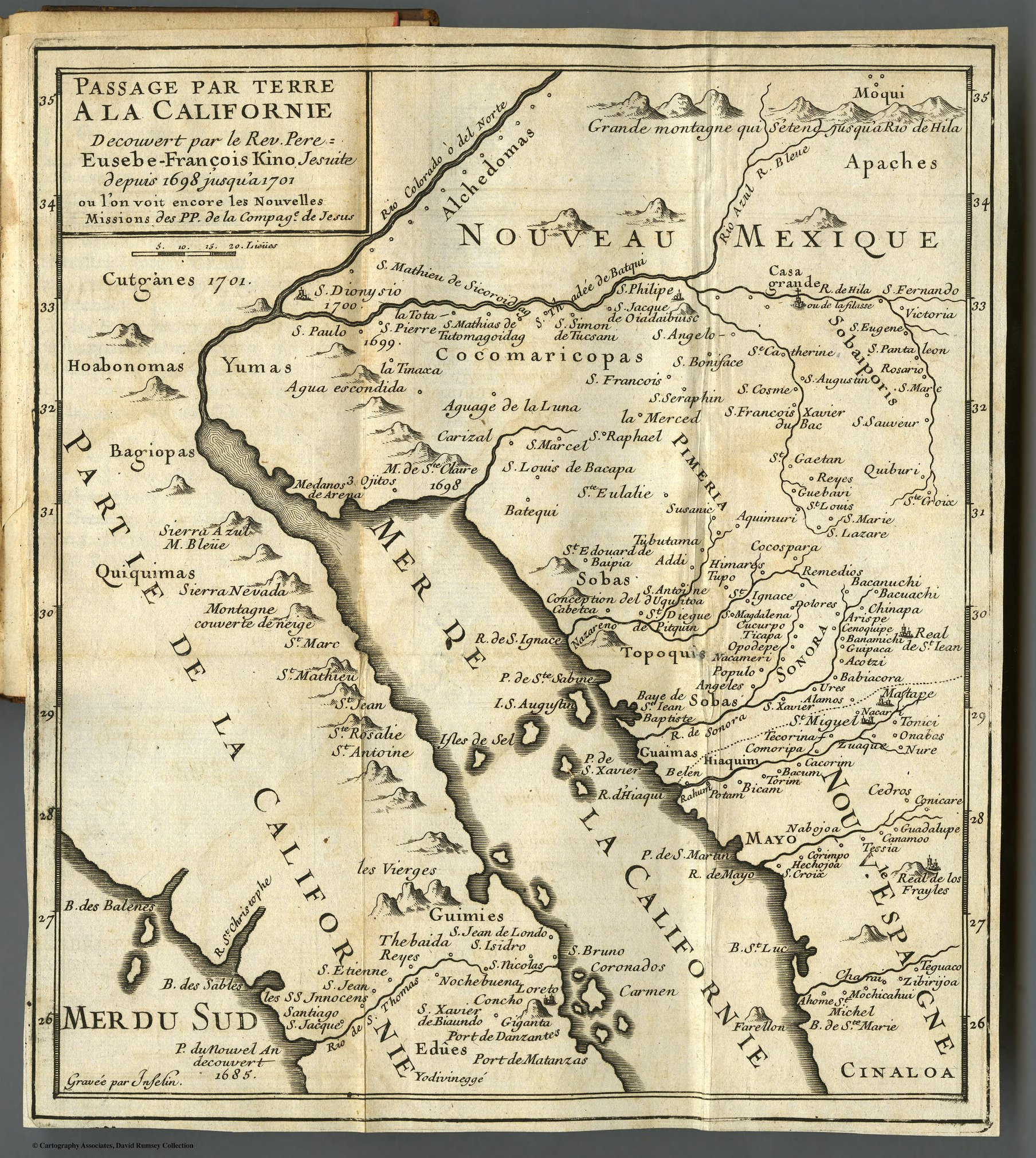
A Jesuit friar, Eusebio Kino, was the first to offer proof against the island theory using the map he compiled in 1701, which was printed in 1705 in Paris. Kino’s map was not readily accepted and it eventually required a royal decree by Ferdinand VII of Spain in 1747 to state that “California is not an Island.”
(text from CaliforniaMapSociety.org)
Simi Valley Fire
Looks like a brush fire erupted in Simi Valley. Check out this interactive map from the Ventura County Emergency Operations Center to see mandatory/voluntary evacuation areas as well as power shutoff areas.
GOES-West Satellite image as of 10am:

New California Mapping
Hema Maps. California, Nevada road guide. 1 map, scale 1:1,000,000. Hallwag, pub. 2019. ISBN: 9783828307568
Michelin North America. Streetwise California: state road map of California. 1 map, scale 1: 2,400,000. Greenville, S.C.: Michein Travel, pub. 2019. ISBN: 9782067238824
National Geographic Maps. Desolation and Granite Chief Wilderness Areas. 1 map, scale 1:40,000. Evergreen, Colo.: National Geographic Partners, Trails Illustrated topographic map 802, pub. 2018. ISBN: 9781566957731
National Geographic Maps. Tahoe Rim Trail. 1 map, scale 1:63,360. Evergreen, Colo.: National Geographic Partners, Trails Illustrated topographic map 1013, pub. 2018. ISBN: 9781566957496
U.S. Bureau of Land Management. Alabama Hills recreational and scenic area, map and guide. 1 map, scale ca. 1:10,480. Bishop, Calif.: Bureau of Land Management, Bishop Filed Office, pub. 2018. Link.
U.S. Bureau of Land Management. BLM routes of travel for western Imperial County, California. 1 map, scale 1:135,000. El Centro, Calif.: Bureau of Land Management, El Centro Field Office, pub. 2019. Link. Link.
U.S. Forest Service. Plumas National Forest, California. 1 map, scale 1:126,720. Vallejo, Calif.: U.S. Forest Service, pub. 2019. ISBN: 9781628114348
U.S. Forest Service. Sequoia National Forest atlas, including Giant Sequoia National Monument: 7 1/2ʹ quadrangle topographic maps. 1 atlas (60 p.), scale 1:63,360. Washington, D.C.?: U.S. Forest Service, pub. 2019. ISBN: 9781628114331
U.S. Forest Service. Shasta-Trinity National Forest atlas: 71/2′ quadrangle topographic maps. 1 atlas (119 map sheets), scale 1:63,360. Vallejo, Calif.: U.S. Forest Service, pub. 2019. ISBN: 9781628114355
Zanger Christopher. Mount Shasta Wilderness. 1 map, scale 1:38,000. Birmingham, AL: Wilderness Press, 4th edition, pub. 2017. Link.
A History of California Wildfires
Check out this interactive map that shows the perimeters of wildfires that have burned in California from 1878 to 2018 using data from the California Department of Forestry and Fire Protection and the U.S. Geological Survey. The wildfires are categorized by the year in which they started. Perimeter information from fires that started between 1878 and 2017 comes from Cal Fire, while information on the Thomas Fire and fires that started in 2018 comes from the USGS.