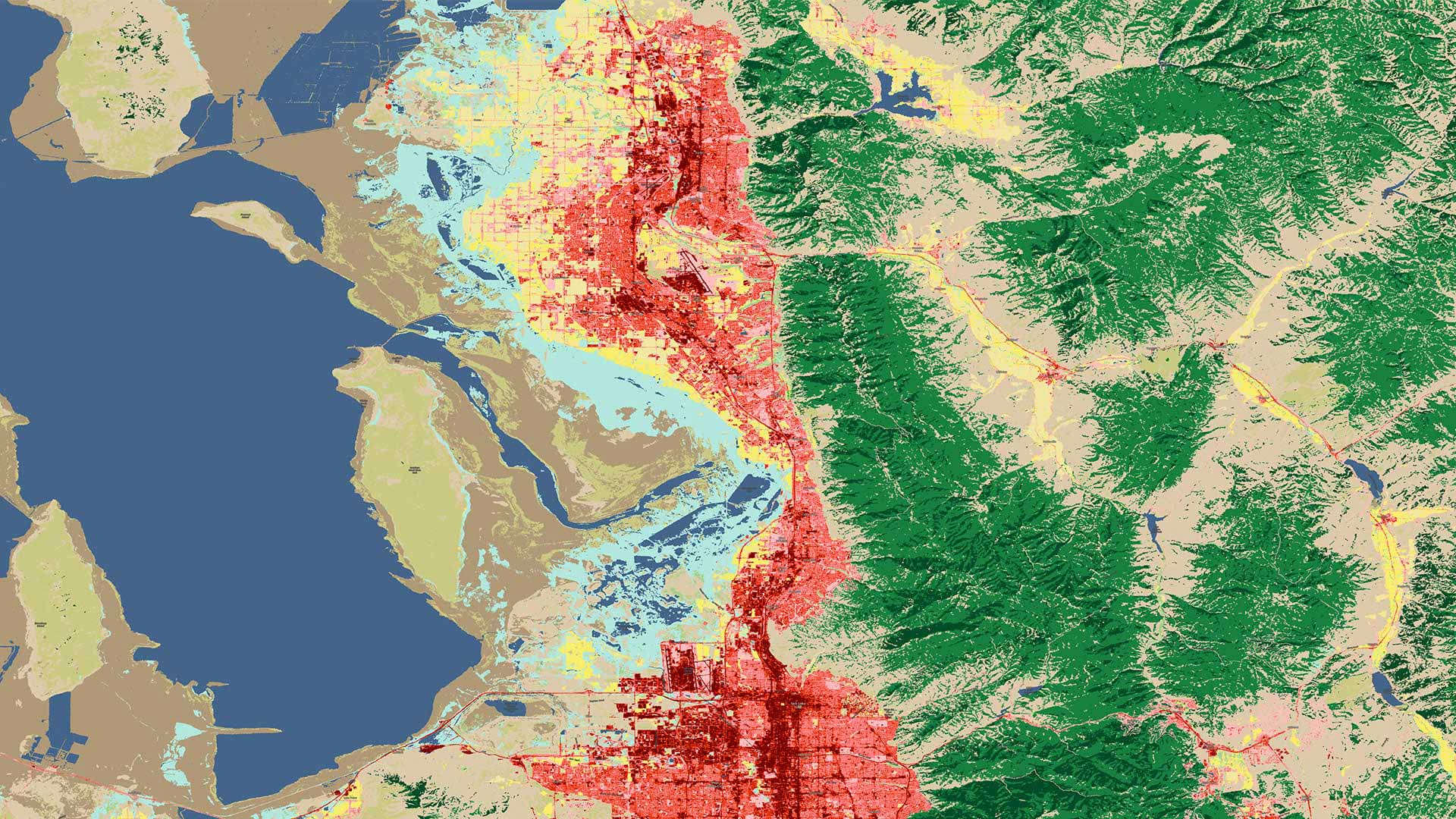
Rio Hondo College GIS will be hosting a field exercise for aerial survey mapping at the Robert Redford Sustainability Center in Claremont on Saturday December 11th 9am to noon. Go check it out.
Field Exercise for Aerial Survey Mapping
1

Rio Hondo College GIS will be hosting a field exercise for aerial survey mapping at the Robert Redford Sustainability Center in Claremont on Saturday December 11th 9am to noon. Go check it out.
After reading up on what the US Census is doing to the 2020 Census data, I have to consider if I can really trust the data to be used for other applications?
You see, the US Census decided to use “differential privacy”, a mathematical technique to introduce statistical noise to “blur” the data. Their reasoning is that because we have powerful computers, anyone could use other data and cross reference the census data to find information on individuals. You can read about it from the US Census here.
However, what happens to the census data, especially at lower levels like the block level, they start messing around with actual numbers of people and other traits like ethnicity, age, sex, etc. For example, according to the US Census, 48 people live on New York’s Liberty Island, but actually no one has lived there since 2012. It also looks like some US States and organizations will be legally challenging the US Census data and the differential privacy technique. To be fair, the US Census has always implemented privacy safeguards using different techniques like “swapping”, but this new technique seems pretty drastic and really not needed. As data scientists duke it out, you can read all about this issue here.
Will you trust the 2020 Census data? You will need to look at it in your own jurisdiction. Burbank’s population strangely went down, so I need to investigate and look at the data more closely. We will need to determine if we can use this data at a tract, block group, or block level to make more informed and accurate decisions. As they say, your mileage may vary. They also say buyer beware!
ESRI and Autodesk are working together to bring GIS and building information modeling (BIM) across multidisciplinary teams and project life cycles. GIS extends the value of BIM design data through visualization and analysis of structures in the context of the natural and built environment. GIS and BIM integrations enable designers and engineers to design smarter, more efficient buildings and infrastructure.
Attend virtually at Autodesk University this year to hear industry leaders discuss GIS integrations for Autodesk and learn how geospatial engineering drives better decision-making. Discover more about ESRI hosted classes and to schedule a meeting at the virtual booth. Click below for more info.

Get caught up on the latest legislation and policy news compiled by the GIS Council Policy Advisory Workgroup. Click here for more info.
Found this interesting article how how you can use a checklist as a guide to review your geospatial strategy or as a final checklist to see if you hit the mark. The checklist includes the following 13 factors:
There will be an ESRI Infrastructure Management & GIS Conference in Palm Springs from October 25-28, 2021. This crossover event provides learning opportunities to users from infrastructure sectors, creating a richer, more valuable experience for organizations to move their location intelligence and GIS forward. Join professionals specializing in the management of infrastructure from several interconnected industries—water; electric and gas; district heating and cooling; pipeline; telecom; transportation; and architecture, engineering, and construction (AEC). Requires proof of vaccination for all those attending this event, and masking is mandatory. More info and to register here.
The United States is experiencing the fourth wave of COVID-19 infections, due to the Delta variant of the virus. The mutation with a coinciding spike in cases was expected, but the rampant nature of the spread across the country poses many questions. First and foremost is, Where do I need to be especially careful?
The interactive map “Which Way Are Things Going?” gives a county-by-county view of active cases for a week-by-week perspective on COVID-19 trends. The map aims to provide accurate and actionable information for everyone, with data from state level to county level that makes it easy for anyone to zoom in and see the trends that will help them make decisions about when and where to better safeguard their health and that of their family.
Click below to view the story map.
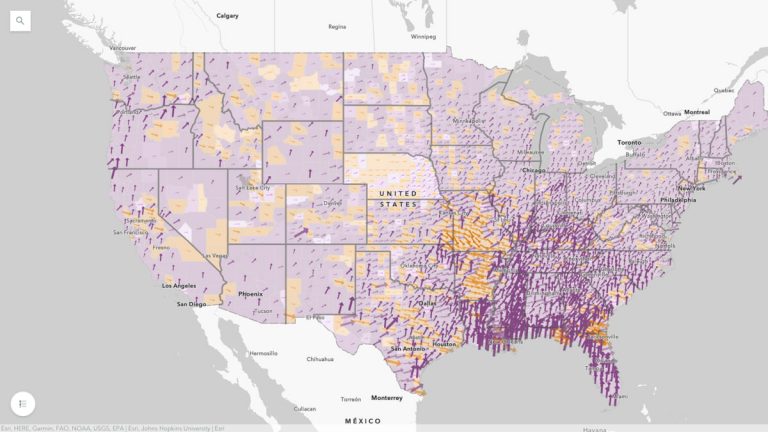
By the way, the source map is also available in ArcGIS Living Atlas for your use in your own apps, dashboards and story maps.
The USGS National Geospatial Program is again updating the US Interagency Elevation Inventory. They would like to know what elevation data you have and ask to update their site so it is discoverable by others. Click here for more info.
Professor Steve Goldsmith of Urban Affairs at Harvard’s Kennedy School interviews Rex Richardson, the president of the Southern California Association of Governments (SCAG), and Darin Chidsey, SCAG’s chief operating officer. One of Richardson and Chidsey’s biggest projects is the creation of a Regional Data Platform that will serve as a data sharing and visualization platform for all of SCAG’s member cities.
Working with federal agencies, ESRI is opening up access in ArcGIS Online to dozens of high-priority, high-demand national data layers, often referred to as A-16 data. These include cartographic boundary files and demographic data from the US Census Bureau; National Agriculture Imagery Program (NAIP) data from the US Department of Agriculture (USDA); and the National Inventory of Dams (NID) database, managed by the US Army Corps of Engineers. Click below to read more about it!