From XKCD.com:


From XKCD.com:
The GIS Certification Institute is hosting a Map Contest. Submissions are open through the end of March 2020. First prize is $250. For more info click here.
Check out this 1947 film about map projections. Film Description: “Development in long-range travel and the growing importance of the Arctic and Antarctic regions make it necessary to understand how maps may be misleading. Experiments with a grapefruit illustrate the difficulty of presenting a true picture of the world on a flat surface and it is concluded that the globe is the most accurate way of representing the earth.” — National Film Board of Canada
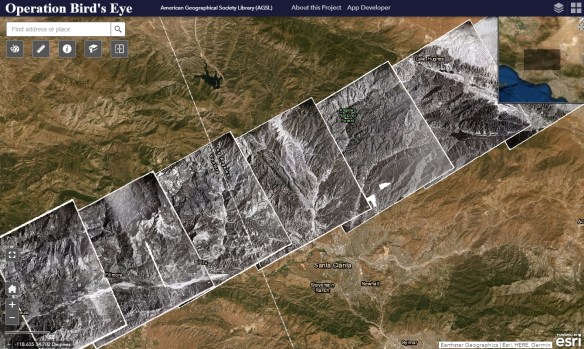
Operation Bird’s Eye is a photographic collection of nearly 400 overlapping aerial images which form a continuous strip spanning the United States from coast to coast. Beginning in Ventura, California and ending over Long Island, New York, these nine by nine inch prints capture a sliver of the American landscape as it looked in 1948. The images were captured during one continuous flight, and when joined together the physical prints stretch 192 feet, showing a slice of land 2,700 miles long.
The flight from which these images were captured took off from the Air Force Flight Test Center (now Edwards Air Force Base) in Muroc, California at 7:40 AM local time on September 1, 1948, first gaining altitude out over the Pacific Ocean before turning east. The plane was a Republic XR-12, an experimental aircraft of which only two were ever built. It was outfitted with K-17 cameras able to shoot a continuous roll of film up to 200 frames. The camera shot at 50 second intervals throughout the duration of the flight, at a constant altitude of 40,000 feet, resulting in a field of vision of around 130 square miles.
The purpose of the XR-12 was photo reconnaissance, and Operation Bird’s Eye was meant as a demonstration of its capabilities. The plane, able to fly high and fast enough to avoid conventional enemy aircraft and fighters, was essentially a flying photography laboratory, with the crew able to process film mid-flight. The Operation Bird’s Eye flight broke records as it crossed the continent, capturing the longest span of aerial photos ever accumulated in a single trip to that point. After 6 hours and 55 minutes, the crew landed at Mitchel Field in Garden City, New York on Long Island.
Click below to read more and check out the images!
Over eighty years after it was originally published, Charles O. Paullin’s Atlas of the Historical Geography of the United States remains one of the most impressive and most useful atlases of American history. Containing nearly 700 individual maps spread across 166 plates, it addresses a broad range of issues. Beginning with a chapter consisting of 33 maps on the natural environment and a second containing 47 maps documenting the evolution of European and later American cartographic knowledge about North America, the atlas mapped an exhaustive number of historical topics: exploration and settlement of the continent, the location of colleges and churches, disputes over international and state boundaries, voting in presidential elections and in Congress, reforms from women’s suffrage to workmen’s compensation, transportation, industries, agriculture, commerce, the distribution of wealth, and military history. Continue reading
Wishing everyone a very Merry Christmas and a Happy New Year. Enjoy this year’s Christmas Card Map! -mike

If you are looking for last minute gifts for that mapper type, check out National Geographic’s site!
As Christmas rapidly approaches … only 7 more shopping days … check out this map by General Mills showing the most popular holiday cookies by state. You can also get the recipes to make them!

Not too long, in the 1800’s, the south half of California almost became a state named Colorado!

The proposal was authored by Andres Pico, a wealthy landowner. Pico was a Californio, part of the Spanish culture that had first settled in the region in the 1700’s.
Long before Americans arrived in the far West, Californio agriculture and trade were thriving. Their problem was the lure of gold. Once the first nugget was discovered in the region in 1848, hordes of settlers rushed to northern California. The Californios were quickly outnumbered, and that’s what led Pico to push for separation. Of course, Pico’s plan would not be the last attempt to split California. California has been the subject of more than 220 proposals to divide it into multiple states since its admission to the union in 1850, including at least 27 significant proposals in the first 150 years of statehood. Pico brought California the closest to separation and never again would a plan have such widespread support. The state legislature, the governor, and the residents were all on board for this one!
Pico’s proposal suggested calling the new state “Colorado”, which by the way ranks among the most coveted state names ever. Votes were taken and the matter was sent to Washington, D.C., for final approval.
BUT … Congress was not listening because they were preoccupied with a tiny matter called the Civil War. It did not happen yet, the year was 1859, but tensions were rising. The folks in Washington just were not interested in California’s plan to slice itself in half.
After southern California’s rebranding attempt failed, the Arizona territory laid its plans to rename itself “Colorado”, however the rectangular state to the north beat them to the prize!
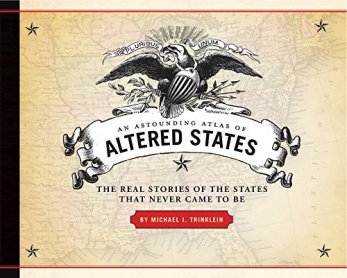 This piece of trivia was taken from the book, An Astounding Atlas of Altered States: The Real Stories of the States That Never Came To Be. Could be a great gift for someone you know!
OK, this might not be the ultimate Christmas gift for some, however if your loved one loves maps and globes … and LEGOs, then this is the ULTIMATE CHRISTMAS GIFT!!!!
You need to get them a LEGO Globe kit! Even the stand for the globe is made of LEGOs! It’s a piece of art for display and geography purposes! There is no excuse! And you can get the globe in different color schemes. It’s not cheap, expect to spend over $800 … your loved one is worth it! Check it out. Only 19 shopping days left before Christmas! 😮

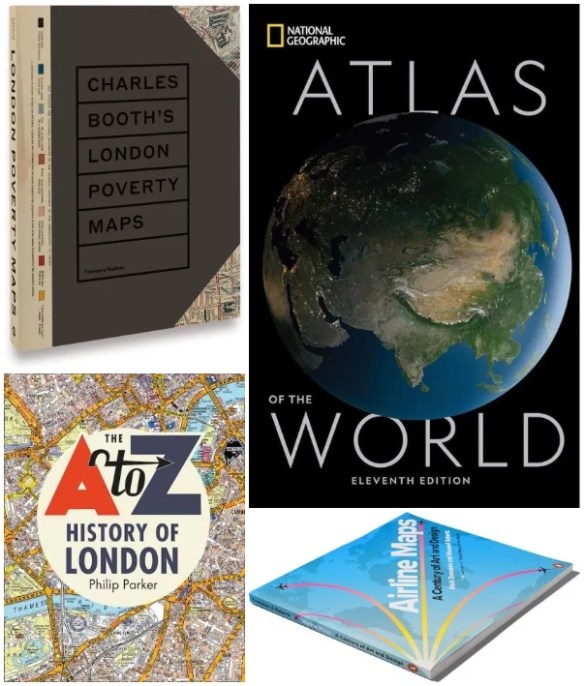
Looking for that perfect Christmas gift for a map aficionado? Check out these ideas in the 2019 Holiday Gift Guide.
 SoCalGIS.org