The Mapmaking Process in 1973

Here’s another one I found for your SoCalGIS info fix … and yes I am catching up from vacation! 🙂  -mike

In 1973, the United States Army produced training film TF5-4523 entitled, “The Mapmaking Process” which it described as explaining the “theory of mapmaking, and illustrates the methods and techniques used to produce maps; planning, surveying, compiling, and reproduction.” Retrieved from the National Archives, the training video is available in three parts for viewing.

Read more and watch the video posted on GIS Lounge:

New USGS Webinar – The National Map Viewer

Hello Pacific Region GIS data users.

In our continuing series of educational GIS webinars for CA, HI, and NV, we would like to follow up the recent EarthExplorer call with one on an equally important USGS data distribution site – The National Map Viewer.

Please join us for a webinar and call on Thursday, January 30 at 11:00 HST, 1:00 PM PST. To sign up for the webinar, just visit the following link to register:

https://usgs.webex.com/usgs/j.php?ED=259146402&RG=1&UID=0&RT=MiM0
Once you have registered for the meeting, you will receive an email message confirming your registration. This message will provide the information (including conference call numbers) that you need to join the meeting. Note that our webinar capacity and phone lines are both limited to 50 people. So depending on the number of people interested, we may not be able to accommodate everyone. But we will monitor the registrations and keep you informed..

This site has lots of GIS-ready data available for free download. We will go over data access, USGS products, viewing data, and web services. Your instructors will be Carol Ostergren and Drew Decker.

From our website (nationalmap.gov/viewer):
Use The National Map Viewer and Download Platform to visualize, inspect, and download our most current topographic base map data and products for free. Managed by the USGS National Geospatial Program (NGP), The National Map Viewer provides access to all eight primary data themes of The National Map to include US Topo and historical topographic map products.
Data include: Elevation, Orthoimagery, Hydrography, Geographic Names, Boundaries, Transportation, Structures, and Land Cover, while products include: US Topo and Historical Topo Maps. The National Map Viewer also allows visualization and identification queries (but not downloads) of Other Featured Data, to include Scanned Topo Maps, Ecosystems, Protected Areas, Gap Analysis Program Land Cover, Wetlands, Public Land Survey System, and National Park Service Boundaries. Also included is a Natural Hazards panel to view hazards-related information, such as for earthquakes, floods, wildfires, and weather, along with the U.S. National Grid for emergency response.

Hope you are able to join us! Contact either of us with any questions.
Thanks,

Carol Ostergren
Drew Decker
——————————————–
Drew Decker
USGS Geospatial Liaison for Pacific Region
NSDI Partnership Office, U.S. Geological Survey
4165 Spruance Road, Suite 200
San Diego, CA 92101
619-225-6430
619-417-2879 cell
619-225-6101 fax
ddecker@usgs.gov
http://liaisons.usgs.gov/geospatial/California/
http://liaisons.usgs.gov/geospatial/Hawaii/
USNG 11S MS 8026 2158

Merry Christmas 2013

As 2013 nears it’s end, I wanted to wish everyone a Merry Christmas and Happy New Year before I go on vacation!  For your viewing pleasure I included this cool 1950’s Christmas map which shows Santa Claus visiting places all over the world.

santa_map

Enjoy!  -mike (Michael Carson, GIS Manager, City of Burbank)

PS – Let me know if you want to host our next SoCalGIS meeting in the new year.  Just contact me at mcarson@burbankca.gov .

The Principal Meridian Project

In 1785 Congress enacted a law stating that the land in the new States were to be surveyed by a grid system consisting of townships 6 miles square and the said townships were to start at a principal meridian and its base line. These initial points were established as needed across the country.

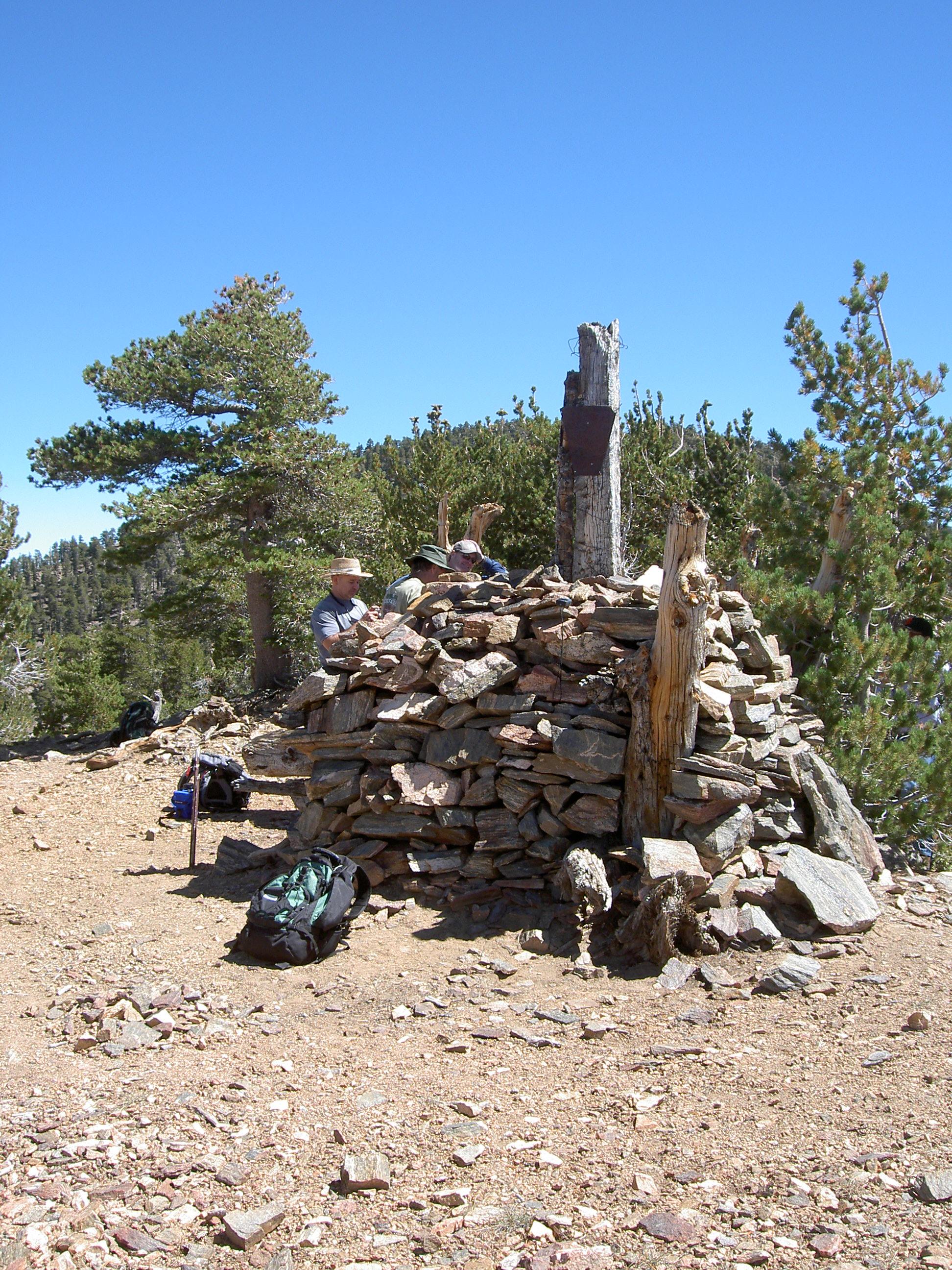
On November 7th, 1852, Colonel Henry Washington, Deputy Surveyor under contract with the United States Surveyor General of California, completed a four day hike with 12 men to a point he designated and monumented to be the Initial Point for the San Bernardino Pincipal Meridian. Nestled at an elevation of 10,300 feet just west of what is now known as Mount San Bernardino, this Initial Point is both the highest and hardest to reach in the entire country. According to surveyor C. Albert White, it is also the only one that has not been altered over time by man. And, to add to its mystique, this point has one other unusual characteristic feature that makes it more unique – it is not alone.

The Principal Meridian Project was started by a group of people devoted to identifying all the base line markers in the country. The group finds the search for meridian markers as interesting as geographers do.  Click on the map below to visit their page and learn more about our Initial Point (or points!) in the San Bernardino Mountains.

EarthExplorer: Your USGS Data Source

The next USGS webinar will be held Dec. 12, 11-12 Pacific. For a better understanding of Earth Explorer, please register and tune in.

EarthExplorer (http://earthexplorer.usgs.gov) provides online search, browse display, metadata export, and data download for earth science data from the archives of the U.S. Geological Survey (USGS). EarthExplorer provides an enhanced user interface using state-of-the art JavaScript libraries, Hypertext Preprocessor (PHP), and the advanced Oracle spatial engine. EarthExplorer is your resource for urban area imagery, Landsat, lidar point clouds, DEMs and other data collected and managed by USGS.

Key features in EarthExplorer include:
• Fast, geospatial search engine
• Map viewer for viewing overlay footprints and browse overlays
• Simple, fast Graphical User Interface (GUI)
• Data access tool to search and discover data
• Textual query capability
• Keyhole Markup Language (KML) export capability to interface with Google Earth
• Save or export queries, results, and map overlay for reuse
• Request on-demand products
• Access to browse images from standard products
• User authentication service for access to specialized datasets and tools
• Access to Landsat Data Continuity Mission (LDCM) quality band data
• Standard product downloads
• User notifications of new acquisitions and available products through subscription services
• Updated software code base supporting JavaScript and PHP

TOPIC: Getting around earth explorer
DATE: Thursday, December 12, 2013
TIME: 11:00 am, Pacific Standard Time (San Francisco, GMT-08:00)

To attend this meeting, you must first register for it. Please click this link to see more information, and register for this meeting.
https://usgs.webex.com/usgs/j.php?ED=192113193&RG=1&UID=0&RT=MiM0

Once you have registered for the meeting, you will receive an email message confirming your registration. This message will provide the information that you need to join the meeting.

5-10 minutes before the start of the webinar, please dial toll free 855-547-8255 or 703-648-4848

Conference Security Code: 30401#
For Help or Support:
Go to https://usgs.webex.com/usgs/mc click Assistance, then Click Help or click Support.

To contact carol ostergren call 1-9162789510 or, email: costergren@usgs.gov

———————————————————–
For help with WebEx:
– Visit https://usgs.webex.com/, click USGS Help (on left)
– WebEx software questions: 1-866-569-3239
– USGS account questions: email gs_help_webinar@usgs.gov
———————————————————–

http://www.webex.com
Thanks for your interest in USGS products and services.

Drew and Carol

Drew Decker
USGS Geospatial Liaison for Pacific Region
NSDI Partnership Office, U.S. Geological Survey
4165 Spruance Road, Suite 200
San Diego, CA 92101
619-225-6430
619-417-2879 cell
619-225-6101 fax
ddecker@usgs.gov
http://liaisons.usgs.gov/geospatial/California/
http://liaisons.usgs.gov/geospatial/Hawaii/
USNG 11S MS 8026 2158

Carol Ostergren
US Geological Survey Pacific Region
National Geospatial Program
3020 State University Drive East, Suite 3005
Sacramento, CA 95819
916-278-9510 (office); 916-278-9546 (fax)
costergren@usgs.gov

http://liaisons.usgs.gov/geospatial/California/
http://liaisons.usgs.gov/geospatial/Nevada/
https://www.facebook.com/USGeologicalSurvey/timeline

Theatrum Orbis Terrarum

With the support of the Friends at KB in 2013 helped acquire a beautiful atlas: a copy of the Dutch edition of the “Theatrum Orbis Terrarum” (Theater of the World) of Abraham Ortelius (1527-1598), published in Antwerp in 1571. The Latin edition of this work was published a year earlier in the same city and is considered the first modern atlas. Until 1612, 41 editions of this work have been published in several languages.

The website is in Dutch, but the atlas images are fantastic.