National Weather Service – Impact Based Statistics

“In an ever-growing effort to provide valuable weather information — or just a vulgar display of automated GIS skills — the National Weather Service is tweeting out images that show how many people are impacted by severe weather. The exercise shows just how little of the United States is populated.”

Thanks goes to Peter King of iWater for pointing out this article.

EIS Mapper

If you deal with environmental issues or if you work with planners who are developing sites, this website may be useful.

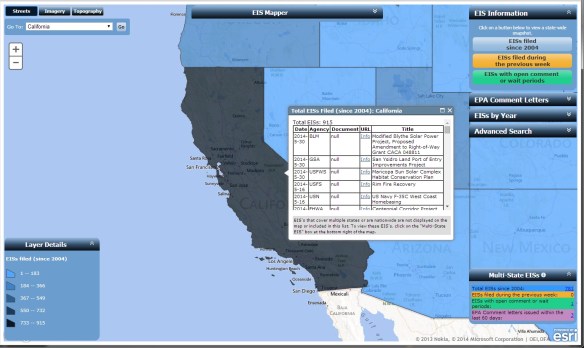
The EIS Mapper displays information for each state with data from EPA’s Environmental Impact Statement (EIS) Database.  Included are EISs filed since 2004 up to the present (previous week), statements with open comment or wait periods, and EPA comment letters.  Using the map application, you gain access to electronic copies of the documents.

The EIS Mapper is a valuable tool for environmental research, planning and municipal developers, property owners, legal research of companies and properties, and for anyone doing historical research on environmental related activities in the United States.  Check it out.

eismapper


Nature Soundmap

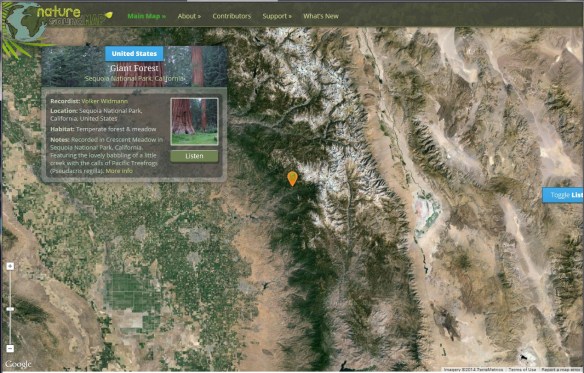
What does a humpback whale sound like? Or perhaps the White-cheeked Gibbon? The Nature Soundmap provides snippets of these sounds and much, much more. Visitors will find an interactive map of the world, complete with markers that allow audio wildlife travel from Central America to Central Asia. Symphonies of animal noises can also be found here. Each marker includes information about the animal or setting profiled, along with a link to More Info for the generally curious.  Click below to check it out.

soundmap

Disasters in the Golden State

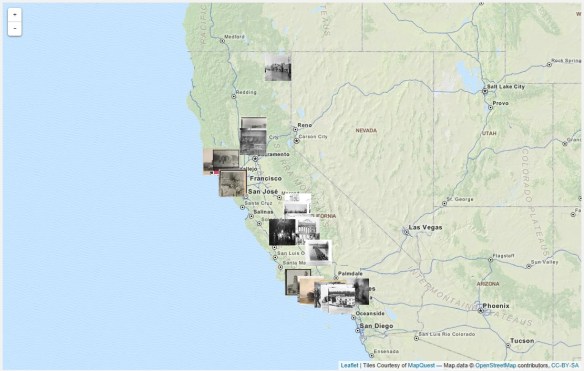
The talented archivists at Calisphere have curated a range of subjects on California history as part of their Local History Mapped series. This particular feature takes on Disasters in the Golden State by looking into the way disasters have affected buildings during the 19th and early 20th centuries. It’s a great subject and visitors can use the View Map feature to explore the state.

calisphere

The homepage provides a brief synopsis of each major disaster type, along with resources for teachers, including class activities based on thematic collections of these images. Additionally the site includes a helpful document titled “How to Use Local History Mapped” and some complementary links from the Joint Committee on Geographic Education.

That reminds me of this book:

It’s very interesting with first hand accounts of California disasters from 1800 to 1900.

Government: Use Your Own Data!

Here is a small but very good example why government should be using their own authoritative data and not depend of Google or Bing!  Too many times I hear “just use Google maps, why should we spend money developing our own data, maps, and apps”.

LA County GIS is constantly setting the bar on developing great data and apps, using it, and sharing too!  -mike

ArcGIS Pro … Soon

During the 2013 ESRI User Conference in San Diego, ESRI demonstrated what they called ArcGIS Professional.  It was still under development at the time, but they said it was slated for a Q4 2013 release.  That did not happen, though maybe it was for beta testing sites?  Not sure.

Now they are saying it will be part of the ArcGIS 10.3 release planned for the second half of 2014.  If you have not seen it yet, below is a video from the ESRI Federal GIS Conference in February 2014.
arcgispro

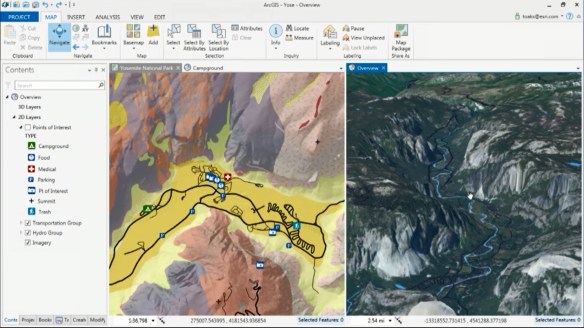
ArcGIS Pro has a ribbon interface that would be similar to Microsoft Excel and Word products.  I personally don’t like that type of interface, the functionality gets lost to me.  Others might find it natural though.

ArcGIS Pro is a 64-bit multi-threaded application that is designed to be the premier application for visualizing, editing, and performing analysis using your local content or content from your ArcGIS Online account or Portal for ArcGIS.  You can author content in both 2D and 3D and publish it as feature, map, and analysis services, 3D web scenes, and web maps.

ESRI states that ArcGIS Pro will not replace ArcGIS for Desktop.  Prediction: I give them 3 years before Desktop goes to live with ArcView 3.

The initial release will not have all the functionality that ArcGIS for Desktop has, but Pro will have capabilities that Desktop does not right now:

  • Project based workflows
  • Combined 2D/3D visualization
  • 64-bit support
  • Multiple layout support

Map documents (.mxd), scenes (.sxd), and globes (.3dd) can be imported into ArcGIS Pro and saved as projects (.aprx).  WHAT?  Having ArcView 3 flashbacks?!!!

ESRI did state that projects are not backward compatible so you cannot go back to ArcMap.  But keep in mind the geodatabases you use in Pro will also be accessible by ArcMap so there can be collaboration at the data level.  Services published with Pro can be shared with ArcMap.  Also, both can run side by side on the same machine.

ArcGIS Pro is part of ArcGIS for Desktop, so only ArcGIS for Desktop customers will be able to receive ArcGIS Pro.  ArcGIS Pro will come in three licensing versions that correspond to Desktop license levels Basic, Standard, and Advanced.  Also, the initial release of Pro will be able to work with the following Desktop extensions: 3D Analyst, Spatial Analyst, Network Analyst, Workflow Manager, and Data Reviewer.

ArcGIS Pro will run on Windows 7 or 8 on a 64-bit machine.  8GB of RAM or more is recommended.

There is no doubt that ArcGIS Pro will be featured at the ESRI Conference in San Diego this year!  Looking forward to it. -mike

Pacific Region Geospatial Data Announcements

From Drew Decker at USGS:

  • National Hydrography Dataset (NHD) releases Web HEM Tool.  HEM stands for Hydrography Event Management and is a tool developed to help relate users’ data to the NHD network as events.  Please see announcement on pages 4 and 5 in the latest NHD Newsletter here:  http://nhd.usgs.gov/newsletters/News_13_6_April.pdf
  • New urban imagery is now available for a number of California cities.  The datasets are natural color and have a one foot resolution.  The data cover the Fresno, Modesto, Oxnard, Stockton, and Sacramento urban areas.  Data can be downloaded through the EarthExplorer site: earthexplorer.usgs.gov (all cities) and The National Map Viewer site: nationalmap.gov/viewer (all except Modesto).

MapStory Webinar Opportunity

If you are interested, you are invited to the seventh webinar of the “Open Geospatial Science & Applications” webinar series on May 15th, 2014.  The webinar will be open and free to all on first come register basis.

This webinar will be on MapStory, the Atlas of Change that everyone can edit.  MapStory is a place to unify and improve our shared knowledge about global change.  Mapstory envision a world where everyone’s wisdom can be tapped, peer reviewed and organised into a non-commercial global data commons that helps us all improve our understanding of global dynamics, worldwide, over the course of history.  Details at http://mapstory.org .

This presentation will be by Dr. Christopher Tucker and is about the MapStory Foundation’s investment in the open source GeoNode, its use to enable crowdsourcing of open spatio-temporal data, and how people can use it to tell their stories to a global audience.  He will be talking about the GeoGit/GeoNode integration that is happening this Summer and how that will open participation widely to users who have as little as a single edit to contribute.

Attendees will be able to interact with the speakers by sending their comments and questions through chat.  All attendees of this web seminar will receive certificates for their participation.  To register visit https://www2.gotomeeting.com/register/922723730 .

The recording will be made available also later for the benefit of the wider community at http://mundogeo.com/webinar/opengeoscienceandapplications/ .