A Map of Every Building In America

This one is interesting!  The New York Times has created a page with an interactive map showing every building in the US.  How did they do this?  They used data from a huge database that Microsoft released to the public this year.  Microsoft’s computer engineers trained a neural network to analyze satellite imagery and extract out shapes of 125,192,184 buildings across the country.  Click below and read on!

usa-big

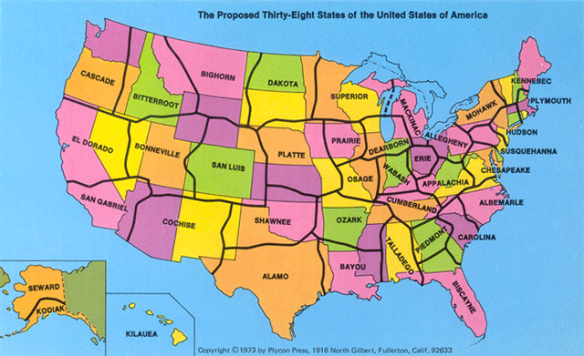
Proposed 38 States of the USA

In 1973, a California State University geography professor suggested that the US redraw its state boundaries and reduce the number of states to 38.  State lines were to be drawn in less populated areas, isolating large cities and reducing their number within each state.  Thus with fewer cities vying for state tax dollars, more money would be available for projects that would benefit all citizens.  Alas, the idea died in Washington.  Click below to read more about it.

38-states_0

More info here.  And here.

How America Uses Its Land

You may enjoy this interesting series of interactive data visualizations showing land use in the continental United States based on different categorizations used by the US Department of Agriculture.  I found it interesting when you organize all the categories together that pasture and rangeland would take up most of the Western US and all of the country’s cities and towns would fit in the Northeast.  Check it out!

uslanduse

California Place Names

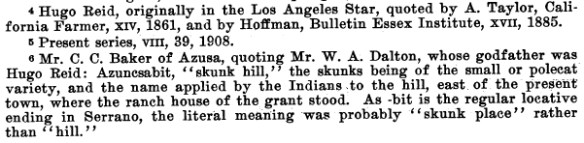
Ever wonder where that place name came from?  I found a scanned copy of a 1916 journal article “California Place Names of Indian Origin” on the UC Berkeley Library website.  Check out this entry for Azusa:

azusa1

azusa2

Ha!  I like footnote #6, and I paraphrase: some guy living in Azusa quotes some other guy who’s godfather said it means “skunk hill” because of the skunks, the small polecat variety, on the hill named “Azuncsabit” by the Indians, east of the town where the ranch house of the grant stood.

And here I thought Azusa got it’s name from the phrase “the best city from A to Z in the USA!”

You can download the PDF of the journal article here.

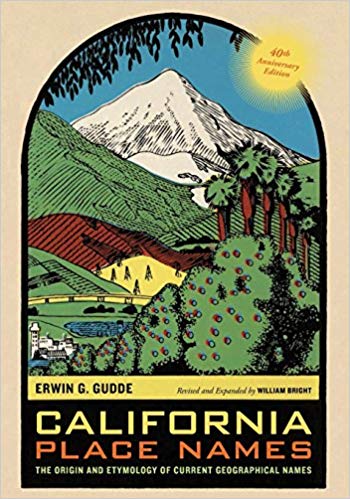
I also bought this book many years ago and it’s pretty interesting if you are into the etymology of place names:

61axgtpo1vl-_sx348_bo1204203200_

Cold War LA

Between 1956 and 1974 those living in Los Angeles had little idea that they were surrounded by numerous nuclear warheads.  16 Nike missile sites as well as radar and control sites were established to defend the Los Angeles area, just in case Russia decided to send their bombers our way.  Read about it and more on the Cold War LA website!

6208296_orig

Phantom Islands – A Sonic Atlas

The term “phantom island” refers to an island that appeared on historical maps (sometimes for many years) even though it doesn’t exist.  Most phantom islands emerged from the era of European sea exploration and colonization.  Phantom Islands – A Sonic Atlas is a project that pairs original sound recordings with 27 phantom islands.  Each of these islands are placed according to their coordinates on historical maps.  Visitors can explore these individual islands by either taking a “cruise” or by navigating with their cursor.  As one visits each island, they will hear a unique soundscape and can read about the island’s history, including the date of the island’s first and last appearance in print.  Check it out!

phantomatlas