Check out the NOAA Coastal Imagery Viewer. The latest for the West Coast is Feb 6-9, 2016. The imagery was acquired to satisfy a wide range of integrated Ocean and Coastal Mapping (IOCM) requirements, such as emergency response and coastal zone management. Continue reading
Monthly Archives: March 2016
No Daylight Savings Time in California?

How do you feel today? How was your commute into work? Feeling a little run-down because you lost an hour of sleep?
ArcGIS Pro Licensing: Back to the Future
Remember Arc/Info and coverages? Coverages were just features stored as files in a directory. Then along came ArcView with data stored in shapefiles, which was different. Then later ArcMap with the ability to store GIS data in Microsoft Access or an Enterprise Database like Oracle or SQL Server. Then came the File based Geodatabase, which was … dejavu … features stored as files in a directory.
Remember ArcView 1, 2, and 3.x? You saved your data view and multiple layouts to a project file (.APR file). Then later with ArcMap you saved your data view and one layout to an .MXD file. Then came ArcGIS Pro with … you guessed it … a .APRX project file to store all your work.
What’s next? When ArcGIS Pro first was released, you had to have a named user account in ArcGIS Online tied to an ArcPro license to use it. At version 1.2, ArcGIS Pro licensing now has more options. ESRI added licenseing the “old way”, with concurrent use and single use licensing options. For concurrent use licensing, you will need the 10.4 version of the License Manager running on a server like you do right now for your concurrent use ArcGIS Desktop licenses.
For more info on this, click here and a short video here.
LANDFIRE Program Needs Your Data
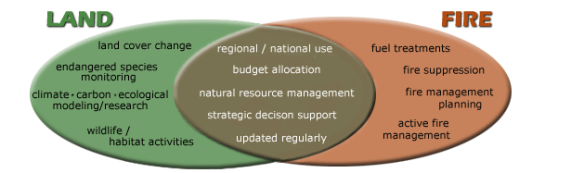
Do you manage or coordinate vegetation or landscape data sets such as field plot/transect data or disturbance/treatment polygons? If so, the LANDFIRE Program needs your data. LANDFIRE is an interagency vegetation, fire, and fuel characteristics mapping program, sponsored by the United States Departments of Agriculture, Forest Service and the Department of the Interior (www.landfire.gov). LANDFIRE data have served as an important data set for programmatic planning, analysis, and reporting for fire and natural resource management.
Is there anything new this year?
LANDFIRE had targeted January 2015 as the key start date for the upcoming remap effort but due to additional data advances with the USGS Land Change Monitoring, Assessment and Projection effort, LANDFIRE is adjusting the beginning of the remap and, as a result, extending the vegetation/fuel plot data call date to March 31, 2016. LANDFIRE is evaluating changing the annual data submission date from January to March for future data calls.
Why should we submit data for remap?
LANDFIRE will be remapping data products with new imagery and new vegetation/fuel plot data to reflect contemporary conditions. There is still time to get your plot data in LANDFIRE, so geospatial landscape data are as reflective of on the ground conditions as possible. Additional plot data have a great potential to improve the quality of the data products especially in areas where lower/limited plot data were available for LF National (circa 2001). For more information on areas that had lower/limited plot data visit: http://www.landfire.gov/participate_plot.php. Locally provided data impact LANDFIRE products and evidence is available for review at http://www.landfire.gov/lf_impacts.php.
What types of data are needed?
Vegetation and Fuel Plot Data:
In preparation for the upcoming remap, LANDFIRE needs contributions of any geo-referenced point, transect, or polygon vegetation or fuel plot data along with any associated digital photos, project descriptions, or final reports. For more information on LANDFIRE’s plot data needs visit http://www.landfire.gov/participate_plot.php where examples of these data and relevant attributes can be found.
Polygon Disturbance and Treatment Activities from 2015/2016:
LANDFIRE uses recent disturbance and treatment data to update map layers in areas where vegetation and fuel have changed. At a minimum, the disturbance/treatment polygons must be attributed by disturbance/treatment (Event) type and year of occurrence. For more information, visit http://www.landfire.gov/participate_contribute.php where examples of these data and relevant attributes can be found.
In addition, LANDFIRE also welcomes feedback on current data products, for more information visit http://www.landfire.gov/participate_feedback.php .
Data Submissions, Contributions, and Thanks:
LANDFIRE collects and welcomes data submissions on an annual basis throughout the year. The data submission deadline has been changed to March 31, 2016 for this data call. Data submitted before March 31 are evaluated for inclusion in the appropriate update cycle, and submissions after March 31 are typically considered in subsequent updates. That said, due to production schedules and the amount of data that needs processing, opportunities to include data that may not have been submitted by the cut-off date often arise. Don’t hold back. Submit data any time.
For more information visit http://www.landfire.gov/participate_refdata.php or contact Brenda Lundberg, LANDFIRE Reference Data Administrator, blundberg@usgs.gov, (406) 329-3405.
LANDFIRE also acquires data from websites and agency data base systems. For a list of these sources see the “Website Agency DB” spreadsheet at http://www.landfire.gov/participate_refdata_sub.php. For a list of past data contributions see the “Compiled Data” spreadsheet at http://www.landfire.gov/participate_refdata_sub.php.
LANDFIRE thanks those who have contributed data in the past and is again asking for your help to enhance and improve LANDFIRE products through your data or information contributions.
Webinar: USGS Structures Database
Hello Everyone:
USGS has a program underway to receive and review crowdsourced data for certain building structure types. Our National Map Corps is managing the Volunteered Geographic Information (VGI) program. VGI provides an editing environment that allows interested persons to add, delete, and modify structures in the USGS structures database. The online VGI editor is based on the popular Open Street Map interface and anyone who is interested can sign up for an account to help us update structures and improve the quality of our data for future release to the public.
Structure types available for editing include schools, colleges/universities, fire/EMS stations, police stations, correctional facilities, state capitol buildings, hospitals, ambulance services, cemeteries, and post offices.
The VGI effort covers all 50 states (though not the Pacific Territories). Your Pacific Region National Map liaisons plan to host a webinar to introduce the VGI program to anyone who is interested in possibly contributing their knowledge of structures to our mapping program. Data contributed through VGI will be vetted by USGS and will reside in the USGS structures dataset. The structures data are available to the public and also appear on USGS products such as new US Topo maps (http://nationalmap.gov/ustopo/index.html)
To read the latest on VGI and help whet your appetite for contributing data please see the VGI newsletters here: http://nationalmap.gov/TheNationalMapCorps/newsletters.html
We are planning to offer this one hour webinar on Thursday, March 31 at 1:00 PM PDT (1:00 PM MST, 10:00 AM HST). To attend this meeting, you must first register for it. Please click this link to see more information, and register for the meeting.
https://usgs.webex.com/usgs/j.php?RGID=rae74b50d93b96bc85f825658d822c340
Once you have registered for the meeting, you will receive an email message confirming your registration. This message will provide the information that you need to join the webinar.
Thanks and please contact us with any questions,
Carol Ostergren
Drew Decker
—————————————————————–
Drew Decker
National Map Liaison for Pacific Region
U.S. Geological Survey
4165 Spruance Road
San Diego, CA 92101
619-225-6430
ddecker@usgs.gov
USNG 11S MS 8026 2158
Carol Ostergren
US Geological Survey National Geospatial Program
CSUS—Placer Hall
6000 J Street Sacramento, CA 95819-6129
916-278-9510
costergren@usgs.gov
ArcGIS for Local Government Recent Release
Some of the new functionality added to the ArcGIS for Local Government solution:
- The DistrictLookup, NearMe, RelatedTableCharts widgets, along with the Plateau Theme, have been incorporated into Web AppBuilder for ArcGIS and as a result, the Election Results, Early Voting, and Election Polling Places solutions can now be deployed in a fully hosted environment.
- The first release of Blight Status, a configuration of ArcGIS and Operations Dashboard for ArcGIS that can be used by local government leaders to proactively monitor the status of blight complaints and efforts made to reduce blighted properties.
- A new set of ArcGIS Pro-based data aggregation tools have been incorporated into the Community Addresses and Community Parcels solutions.
- The first release of Vision Zero, a configuration of ArcGIS that can be used by the general public to report transportation hazards and dangerous traffic behaviors on roadways.
Many more enhancements as well. Click here for more info.
Mapping the Nation: Building Smart Government with GIS
Mapping the Nation: Building Smart Government with GIS, a new book from ESRI, illustrates the many ways government uses maps created with geographic information system (GIS) technology to create safer, healthier, and more resilient communities.
This is the 6th book in ESRI’s Mapping the Nation series. Chapters of the book are devoted to over 100 maps related to public safety, public policy, national mapping and statistics, education, health, the environment, and humanitarian work.
Finally: Tallest Building in LA Gets an Observation Deck … and Skyslide!
The US Bank Tower in downtown LA (formerly Library Tower and First Interstate Bank World Center) is a 73 story, 1,018 foot tall skyscraper at 633 West Fifth Street and is the tallest building west of the Mississippi River (11th tallest in the US). The building was constructed from 1987 to completion in 1989.
For many years I wondered why the tallest building in downtown LA never had an observation deck. It was a bummer not to have one, especially on our tallest building! But finally in July 2014, the owners of the skyscraper announced construction of an observation deck on the 69th and 70th floors, a restaurant on the 71st floor, and a glass slide outside to slip from the 70th floor to the 69th!
It should all be ready for you to try out by mid-2016. Check it out!
And if you wait until 2017, the new 73 story Wilshire Grand being constructed now will have its own sky-high observation deck and restaurant, plus an infinity pool on the rooftop!
ESRI Goes Big With SGELA
ESRI has supersized their Small Government Enterprise License Agreement (SGELA) which now includes local governments serving populations up to 250,000.
With an ELA, you have access to ESRI’s core products (Desktop, Server, Engine, Runtime) and extensions, with as many installs of the software that you need. You also get an ArcGIS Online account for your organization, Portal for ArcGIS, CityEngine, access to ESRI Developer Network (EDN), Virtual Campus dollars for web training, instructor-led training discounts, and User Conference passes. All for a pretty reasonable price per year for 3 years. For example, Tier 4 runs about $50,000 per year. Get your SGELA today and start expanding your organization’s access to GIS services and products!