This year CalGIS and URISA GIS-Pro will be combined together in Palm Springs on October 9-12 2018.
There is a call for presentations right now.
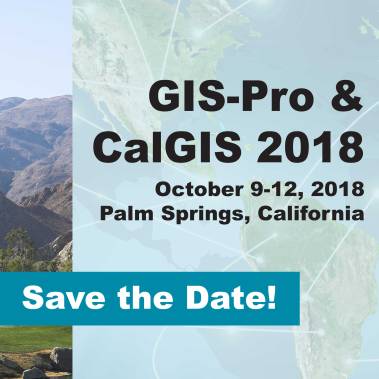
Get signed up to present and let’s have great representation from SoCal!
This year CalGIS and URISA GIS-Pro will be combined together in Palm Springs on October 9-12 2018.
There is a call for presentations right now.
Get signed up to present and let’s have great representation from SoCal!
Reduced funding from federal partners are causing the USDA Farm Service Agency to explore funding and licensing options for NAIP. NorCal URISA is holding a public forum to have a conversation across the community about NAIP and perhaps bring more use cases and needs forward that might otherwise go unaided. A representative from USDA is planning on attending this meeting and giving a short overview, after that there will be an open discussion about use cases for how you have been using NAIP. Your use cases will be assembled for our friends at the USDA and Save the NAIP so that they can have more examples about the far-reaching benefits of this valuable dataset.
The in-person meeting will be held on January 25th, 2018, from 2pm to 4:30pm PST at: West Sacramento Galleria – 1110 West Capitol Ave, West Sacramento, CA 95691.
There will also be an online webinar for the meeting as well. Please register in advance if interested.
Interesting article about moving from ArcGIS to open-source GIS, though be aware in the end this consultant is trying to sell you training. I would disagree with the author’s statement:
Many people who come from an ESRI-centric GIS education tend to think that ESRI is the standard because it is the most popular commercial GIS software, but in fact the opposite is true. Most open source GIS software will yield the same results because they implement the same SFS geometry model and the same GEOS vector functions. But ESRI software may not, because it uses its own proprietary geometry model and its own proprietary spatial functions.
He does go on the say ESRI’s software has been around a long time and stood the test of time. I would argue that Continue reading
Many companies are becoming more open about how and where their products are manufactured. The Nike Manufacturing Map is an interactive map which shows the location of independent factories contracted to make Nike products. The map also allows you to access information about the product made by each factory and data about the employees. Continue reading
Wondering how the boundary of Los Angeles County looked like in 1851? Here you go:

Here it is in 1887, just before Orange County was created the year after:
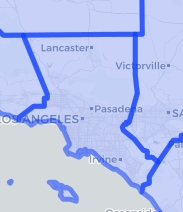
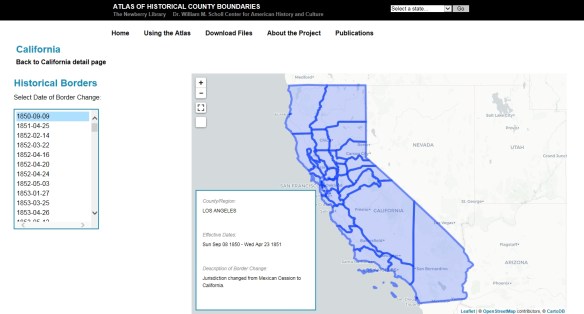
The Atlas of Historical County Boundaries allows you to explore how county boundaries have shifted throughout history. You can also download GIS shapefiles of polygons for each different configuration of a state’s counties or the entire United States, coded by date. Check it out!
The California Geologic Survey (CGS) Seismic Hazards Program has significantly updated two versions of its regulatory hazard zone map products. First, all GIS data files (in ESRI Shapefile format) for fault rupture, liquefaction and earthquake-induced landslide zones have been re-projected to California (Teale) Albers, in meters, with a North American Datum 1983. In addition, all GIS zone polygons now include attributes that provide the name of the 7.5-minute quadrangle, map release date(s), and links to zone reports and PDF maps. Active fault traces within earthquake fault zones have attributes for fault name and fault type. Continue reading
Did you miss it? Probably not.
Some of you might have known about this last year. I never reported on it since the story kept changing throughout 2017. However, if you missed the controversy, ESRI was going to phase out the ability to use Concurrent Use licensing starting with ArcGIS Desktop 10.5. Continue reading
The Interdisciplinary Earth Data Alliance (IEDA) data facility aims to, “support, sustain, and advance the geosciences by providing data services for observational geoscience data from the ocean, earth, and polar sciences.” The IEDA, which is funded by the US National Science Foundation, is headed by staff at Columbia University’s Lamont-Doherty Earth Observatory. On this website, you will find a number of data repositories and data syntheses, which are collections of data sets with a shared area of investigation. Data repositories include information in the fields of Antarctic science, marine geology and geophysics, and geochronology. You can also download the free GeoMapApp, which is a free software tool for creating data visualization. Check it out!

Wishing you all a very Merry Christmas and a Happy New Year. Enjoy this year’s Christmas Card Map! -mike

If you are looking for last minute “map” type gifts. Check out this site!
Whether you are an ArcGIS Online subscriber or an ArcGIS Hub user, you can launch an open data site in 3 steps, which include configuring and designing the site and making it public. Check out ESRI’s post about it here.
 SoCalGIS.org