MaptimeLA is a group of people working on maps, learning about geospatial data, and teaching each other the latest cartographic tools. Check them out and join today. They are also on Twitter.
MaptimeLA
Reply

MaptimeLA is a group of people working on maps, learning about geospatial data, and teaching each other the latest cartographic tools. Check them out and join today. They are also on Twitter.
The History of Cartography Project has been awarded a five-year grant from the National Science Foundation to study the origins and development of modern cartography. The research will facilitate preparation of Cartography in the Nineteenth Century, Volume Five of the groundbreaking History of Cartography series.
This unique, international research and publishing venture, based at the UW-Madison, is dedicated to promoting a deeper understanding of cartography among scholars and the general public. The first three volumes of the series are available in print and are freely available online. The final three volumes will be published in print, as e-books, and online as well.
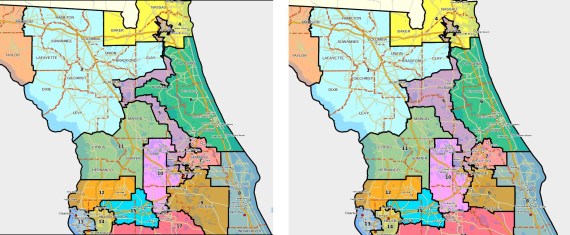
There is a map fight brewing in Florida. Florida legislators completed their hasty fix of a congressional redistricting map in an attempt to address the concerns by Circuit Court Judge Terry Lewis, who said the map violated a constitutional ban on partisan gerrymandering. Click below for a fun read.
The Health and Medical Geography Specialty Group (HMGSG) invites current undergraduate and graduate students to submit their work to the specialty group’s annual Peter Gould Student Paper Competition. The competition is meant to promote written scholarship by students across the field. Single-authored papers from any medical, health, disability and/or health systems related topic are encouraged.
The deadline for submitting an extended abstract is November 2, 2014.
More information here.
Though the prize is only $100, having your name associated with Peter Gould’s would be a very good thing for an up-and-coming student’s career!
And while you are at it, join the AAG!
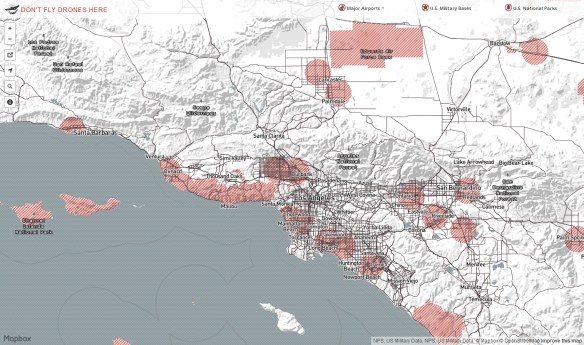
This interactive map represents areas where it is not permitted to fly drones due to current FAA regulations. Brought to you by Mapbox.
The introduction of unmanned aerial vehicles (UAVs), or “drones,” into the U.S National Airspace System for commercial use raises a number of complex legal and policy issues. Understanding what is currently permitted is made more challenging by almost-daily reports of new court decisions, proposed regulations, possible executive orders and Federal Aviation Administration (FAA) approvals granted for certain restricted uses. This webinar will clarify the current status of UAVs in the United States and raise important future issues.
This week the US Energy Information Agency announced the availability of a new mapping tool that details the flood risk faced by our existing energy infrastructure. The map has icons located on sites like distribution terminals and power plants and allows users to overlay the existing flood risk on those sites. The clear message is that a lot of our infrastructure is already at risk.
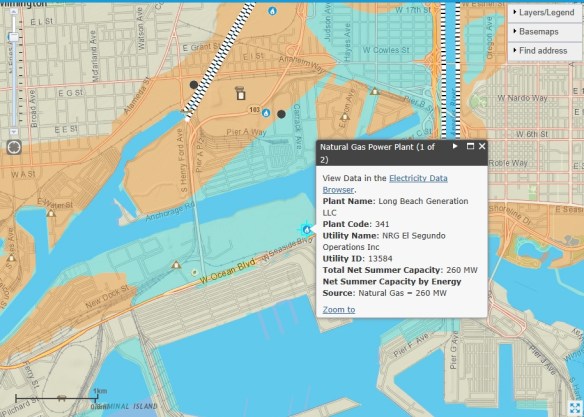
Flood hazard information from FEMA has been combined with EIA’s energy infrastructure layers as a tool to help state, county, city, and private sector planners assess which key energy infrastructure assets are vulnerable to rising sea levels, storm surges, and flash flooding.
Ventura College GIS course starts soon.
Course Name: Introduction to GIS Software (GIS/GEOG 26)
Course Info: Monday and Wednesday evenings, 7-8:50pm. Starts August 16th. Ends October 17th. (9 weeks)
Enroll now at http://www.venturacollege.edu/apply-and-enroll/registration
Introduction to GIS Software features ESRI’s ArcGIS 10.2 and covers core concepts and skills related to GIS. The course is valuable to those new to Geographic Information Systems and those seeking to build on their current knowledge and experience.
The next time, after this semester this class may be offered is in Spring 2016!
Please sign up right away if you are interested.
Details on application process and enrollment (exemptions apply for those who are taking the class for professional purposes)
http://www.venturacollege.edu/apply-and-enroll/application-for-admission
For more information contact Steve Palladino, spalladino@vcccd.edu.
Want to know what Yosemite National Park looks like right now? I found this interesting app that takes you on a map tour of our National Parks via live webcams.
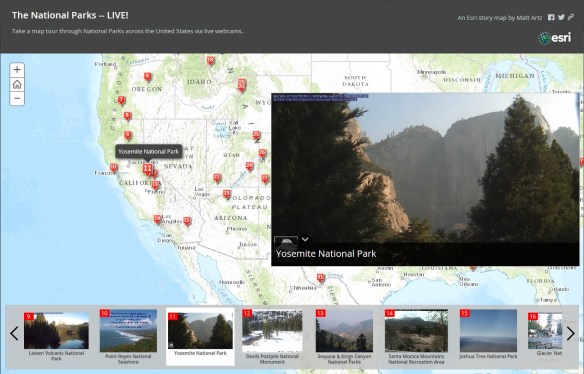
I found some of the webcams not working or displaying an old image, but the ones that do work give a great picture of that area about the time you load the app. I found if you reload the app a few minutes later, those webcams that are working will update their video feed. Pretty cool.
Have you ever wanted to get a very quick view of what’s in the NHD for an area that you haven’t downloaded? Even if you have the data on your hard drive, I’ve found the quickest way to see the basic NHD features is through the ArcGIS Online (AGOL) viewer. I’ve made a very simple web map in AGOL that accesses an NHD dynamic map service from The National Map (TNM). To give it a try, open this link: http://bit.ly/1puvHOn
Zoom to your area of interest. You can use the standard map zoom tools, or type in a place name or street address in the search box in the upper right of the window. You need to be zoomed in to a scale where the NHD streams can be displayed reasonably. If you don’t see any streams on the map, click on the “plus” symbol in the upper left corner of the map to zoom in more. Notice that in the legend there is a scrollbar once you’re zoomed in so that streams begin to display. The NHD streams are called “Flowline – Small-Scale” or “Flowline – Large Scale”, and appear at the bottom of the legend. You will need to zoom in so that the scale bar in the lower left corner of the map shows one mile or less to see the ephemeral streams, which are in a dashed brown line style. (Note that ephemeral streams are not shown in all areas.) Intermittent streams are shown in a light blue dashed line style. If you have used this service in the past, you may notice that the symbology has changed recently.
There are several other map services from The National Map that might be of interest to you. A listing can be found here: http://viewer.nationalmap.gov/example/services/serviceList.html. You can bookmark that URL, or just remember this: Search for The National Map, go to the main page, and on the left under Products and Services, click on the Framework Web Feature Services link. You should be able to open the ArcGIS Online map above without having an AGOL login account. If you do have an account, you can save the map as your own and customize it as you like. The TNM services listed above may also be added to your map, along with anything else that is out there on the web.
 SoCalGIS.org