Two meetings you should be aware of:
Geospatial LA – September 18th in Silverlake
Maptime LA – October 2nd in Los Angeles

Two meetings you should be aware of:
Geospatial LA – September 18th in Silverlake
Maptime LA – October 2nd in Los Angeles
For at least a century, the moving rocks of Death Valley have presented a puzzle, and researchers have been trying to solve it since 1948. The rocks, some of them boulders weighing more than 600 pounds, show signs of movement across the desert floor by leaving long trails behind them.

Explanations including dust devils, flooding, hurricane-strength winds, and even UFOs have been offered, but the mystery was finally solved when researchers caught the rocks in the act!
Check out the National Geographic article and watch the video below.
Most people do not realize that the original vision of Walt Disney World included a plan for an Experimental Prototype Community of Tomorrow (E.P.C.O.T.), known today as Epcot.

E.P.C.O.T. was Walt Disney’s one of a kind project composed of several elements which included a prototype community, an industrial park, an airport of the future, a Disneyland type theme park, transportation systems, and much much more.

All these elements were imagined by Walt Disney and his staff with new and advanced designs and technologies. The project was conceived between 1962 and 1966 and even if it did survive a couple of years it was stopped in the mid 70’s and never developed. Some elements did survive in the Walt Disney World resort as we know it today, but so much more was planned. Unfortunately, the project lost it’s main energy: Walt. Walt Disney died just two weeks after filming the “E.P.C.O.T. film” in 1966, a promotional film created for the media and investors. The film is a great Disney landmark since it’s the last movie of Walt Disney alive and since it’s content is Walt Disney’s last and unbuilt dream … E.P.C.O.T.

Check out the website and watch the film. Walt Disney was very focused on transportation and how to move people and goods around. If you are into urban planning and design or transportation, this piece of history will be very interesting to you! Click below to check it out.

Almost looks like a GIS map!
The U.S. Geological Survey will host an educational event for the news media focused on earthquakes on Wednesday September 24, 2014. The goal of the event is to provide the press an opportunity to work with USGS staff to build knowledge about and confidence in the information delivery systems and people to create more timely and accurate reporting of earthquakes.
At this event, USGS scientists and public affairs staff will lead sessions in which journalists can refresh knowledge about basic principles about earthquakes, how to improve scientific accuracy when reporting on earthquakes, and about USGS resources to make your job easier. Find out about USGS public domain maps, images, and graphics that can be quickly and freely downloaded and reused following an earthquake.
Who: USGS geologists, geophysicists, and public affairs. See list below.
What: 30-minute plenary session with presentations on reporting on earthquakes and relevant USGS resources, followed by concurrent small group discussions with USGS researchers on various aspects of earthquake science. Subjects will include:
When: Wednesday, September 24, 2014, 10:00 a.m. – 11:30 a.m. PDT
Registration: Please register online to participate in the workshop.
Where: U.S. Geological Survey, Main Auditorium, Bldg. 3, 2nd floor, 345 Middlefield Road, Menlo Park, Calif.
Online: The first 30 minutes of the event will be live video-streamed over the web, and archived online for later viewing.
So you moved your GIS data and now you need to update your MXD files with all those layers that point to the old data location. What to do? Use ArcCatalog to update them. I’m using version 10.2 here.
First open ArcCatalog and navigate to the location of your MXD files. Next, right click on one of the files and select “Set Data Source(s)…”

You can then edit your data paths by selecting the ones that need editing, then pressing the Replace button:

After you change the paths, make sure to enter a new MXD file name, then press the OK button. That’s it!
Over the years, making a globe is still mostly a manual process.
Making a globe in 1935:
Globe making in 1955:
Making a globe today:
Maptime LA will have their first meetup this Thursday in downtown LA. To RSVP, visit http://www.meetup.com/MaptimeLA/events/204145932/ .
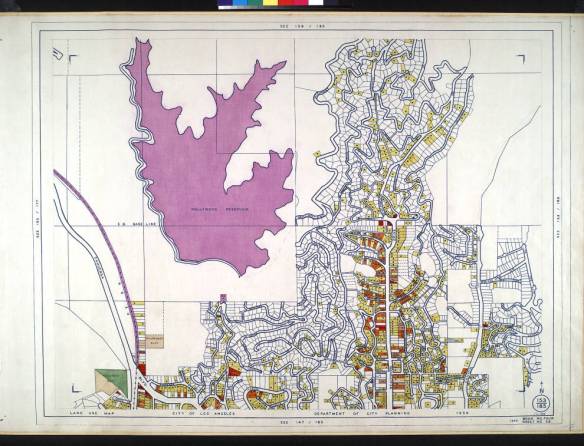
Developed as part of President Franklin D. Roosevelt’s massive package of assistance programs designed to pull the United States out of the Great Depression, the Works Progress Administration (WPA) was known for employing thousands of artists to paint murals in federal buildings and for also employing thousands of the nations’ unemployed in hundreds of massive construction projects around the country.
One of these many programs was also designed to create maps of various locales. The WPA conducted a land use survey from December 18, 1933 to May 8, 1939 for the City of Los Angeles, Department of City Planning. It covered approximately 460 square miles within the boundary of the City of Los Angeles and resulted in a series of 345 hand-colored land use survey maps. They are collected in 10 books (averaging 35 maps per book) each corresponding to a geographic region within the City’s boundary. The books cover:
Each original map measures approximately 2 ft. x 3.5 ft. The maps themselves identify whether land was vacant or used for commercial, farming, residential, industrial, manufacturing, or recreational purposes.
A website, provided by USC, allows users access to the 345 maps. Along with viewing various maps of the different neighborhoods throughout the city, you can search the contents of the maps. Check it out.
NAPSG Foundation is holding a one-day Los Angeles Region Summit on September 15, 2014, in Los Angeles, California. Just one block from the historic Union Station in downtown Los Angeles. This event will convene current and new NAPSG partners from the Los Angeles Region and across Southern California, from all public safety disciplines and levels of government.
The Summit will provide you with an opportunity to learn about the status of Public Safety GIS in the Los Angeles Region and to interact with other public safety officials and GIS professionals.
Who Should Attend? Operations and technical public safety officials, across all disciplines, who are interested in learning more about the requirements and application of GIS in day-to-day public safety operations.
Including:
Please find the event agenda here.
Here is an interesting map and article about the spread of the military’s surplus gear in state and local police departments. The data is grouped by county and you can filter by aircraft, armored vehicles, body armor, grenade launchers, night vision, and assault rifles. In LA County there are 3 mine-resistant vehicles … they probably work well with all the potholes around here too!

 SoCalGIS.org