US Interagency Elevation Inventory

Dear colleagues,

The USGS National Geospatial Program is again updating the US Interagency Elevation Inventory. We invite you to provide us information so that your data is discoverable by others. Your data need not be in the public domain, and the entry will provide a link to inquire about the data, or to a download site if available. This is not a repository for data; it is a way to make data findable. If you have high quality lidar data you wish to donate to USGS data repositories, we can have the conversation at any time.

https://www.coast.noaa.gov/inventory/

If you wish to make your data discoverable through the inventory, we will need the following:
  • Shapefile footprint with metadata
  • Vendor tasking, if available
  • Status (in work, available, etc.)
  • Restrictions (if it is public domain)
  • QA or acceptance reports (so we can calculate quality level)
  • Contact information (for internal purposes only; no PII will be publicly posted)
  • url for download or public inquiry (if available)
Due dates are as follows:
  • Arizona (to Drew by COB 3/25/2019)
  • Nevada (to Carol by COB 3/11/2019)
  • Hawaii (to Drew or Carol by COB 3/25/2019)
  • Pacific Basin Islands (to Drew by COB 3/25/2019
  • California (to Drew or Carol by COB 3/25/2019)

If you have an awareness of data that you did not procure, we are happy to chase down the source if you can provide a pointer to a contact person. We try to duplicate what currently shows in both NOAA’s digital coast and Opentopography.org. If you have updates to an existing entry on the inventory, please let us know by the due dates above.

Any questions, please call either one of us, and feel free to pass this request along to others inside or outside of your organization so that our inventory can be as up-to-date as possible.

Sincerely,

Carol and Drew

Drew Decker
National Map Liaison
U.S. Geological Survey
4165 Spruance Road
San Diego, CA 92101
619-225-6430
619-417-2879 cell
ddecker@usgs.go

Carol Ostergren
US Geological Survey National Geospatial Program
2885 Mission Street
Santa Cruz, CA 95060
831.460.7539 (office)

California Releases Interactive Public Geoportal

California has adopted a massive, interactive online database of location-based government data that includes over 1200 publicly available data sets from 25 state entities.

The California State Geoportal collects geospatial data from government agencies including housing, water, transportation and health information. The data is compatible with geolocation software and is designed to be shared, layered onto maps and analyzed.

The portal was designed by ESRI.  Check it out!

calgeoportal

Mapping 2019-nCoV

On December 31, 2019, the World Health Organization (WHO) was informed of an outbreak of “pneumonia of unknown cause” detected in Wuhan City, Hubei Province, China – the seventh-largest city in China with 11 million residents. By January 23, there was over 800 cases of 2019-nCoV confirmed globally, including cases in at least 20 regions in China and nine countries/territories.  As of this writing, there are now 17,485 confirmed cases and 362 deaths!

Continue reading

Geographic Masking

Geographic masking is a technique used to basically move your data around so not to give away the exact geographic coordinates of individual level data.  This is done when locations of individuals (like in health data, crime data, or endangered species data) need to be “anonymized” so they cannot be re-identified through reverse geocoding.

One tool that does this is MaskMy.XYZ.  MaskMy.XYZ helps users perform a time-tested geographic mask from the scientific literature, known as donut masking. Instead of being a toolbox for a specific (potentially expensive) GIS software suite, MaskMy.XYZ uses popular open source JavaScript libraries to mask data without ever requiring users to install or download any software. So whether you’re a GIS expert who can’t be bothered to script this method yourself, or a GIS newbie who knows you need to mask your data but aren’t quite sure how, MaskMy.XYZ makes your life easier and brings previously cumbersome methods into reach.

Everything runs client-side in your browser, meaning there’s nothing to install, data never leaves your computer, and as a result nobody except you ever sees your confidential files. It is a safe and secure way to anonymize spatial data.  Finally, you can map your secret fishing spots and share them with others without giving away the exact locations!  Check it out!

instructions

You Are Being Tracked!

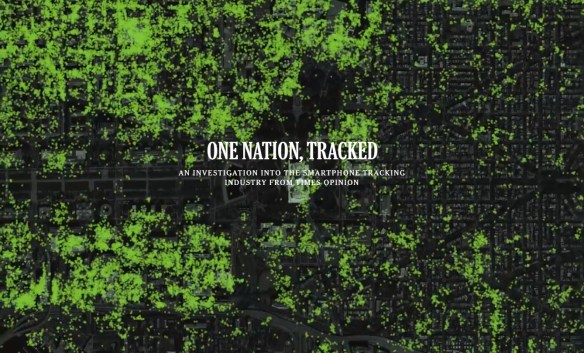
Here is a scary report from New York Times on how our personal locations are being tracked, and mostly from unregulated location data companies that cross reference your location with other databases to figure out who you are, where you live, and where you have been.

“In one case, we observed a change in the regular movements of a Microsoft engineer. He made a visit one Tuesday afternoon to the main Seattle campus of a Microsoft competitor, Amazon. The following month, he started a new job at Amazon. It took minutes to identify him as Ben Broili, a manager now for Amazon Prime Air, a drone delivery service.”

Click below to read the report, and parts 2 to 7!

tracked

Report: California Needs GIS Officer

A government watchdog agency recommended that Gov. Gavin Newsom and the state Legislature create the position of state Geospatial Information Officer to coordinate and advance the use of GIS technology across all departments.

The Little Hoover Commission’s report on geographic information systems technology, called Mapping a Strategy for GIS, follows a study of whether the state government is using GIS to its full capacity and in a cost-efficient manner. The report concludes that overall, the state’s use of GIS is “inconsistent and lacks centralization and coordination.” The 18-page document recommends that the governor and Legislature take three specific steps:

  • Designate a full-time state Geospatial Information Officer
  • Create a GIS Advisory Council, whose members would come from the public sector, the IT industry and nonprofits
  • Use GIS technology to evaluate regional disparities in funding and the delivery of state services.

Click here to read the Techwire article.  Click here to read the report.

Fire Operations Technology Summit

ESRI is hosting a Fire Operations Technology Summit at their headquarters in Redlands on January 22-23, 2020.

The Fire Operations Technology Summit is a two-day exclusive event that will bring together fire operations chiefs from across the state and emerging technology partners servicing fire and EMS industries with the goal of improving daily operations and firefighter safety.  Learn about real world tech being developed for the fire service of tomorrow and used by the fire service of today.

The summit is free, click here for more details and to register.