If you are looking for a school with the best overall Graduate Geography Program for a spatial career, check out this posting on Geographical Perspectives.
Top Graduate Geography Programs 2015
Reply

If you are looking for a school with the best overall Graduate Geography Program for a spatial career, check out this posting on Geographical Perspectives.
The U.S. Geological Survey will host an educational event for the news media focused on earthquakes on Wednesday September 24, 2014. The goal of the event is to provide the press an opportunity to work with USGS staff to build knowledge about and confidence in the information delivery systems and people to create more timely and accurate reporting of earthquakes.
At this event, USGS scientists and public affairs staff will lead sessions in which journalists can refresh knowledge about basic principles about earthquakes, how to improve scientific accuracy when reporting on earthquakes, and about USGS resources to make your job easier. Find out about USGS public domain maps, images, and graphics that can be quickly and freely downloaded and reused following an earthquake.
Who: USGS geologists, geophysicists, and public affairs. See list below.
What: 30-minute plenary session with presentations on reporting on earthquakes and relevant USGS resources, followed by concurrent small group discussions with USGS researchers on various aspects of earthquake science. Subjects will include:
When: Wednesday, September 24, 2014, 10:00 a.m. – 11:30 a.m. PDT
Registration: Please register online to participate in the workshop.
Where: U.S. Geological Survey, Main Auditorium, Bldg. 3, 2nd floor, 345 Middlefield Road, Menlo Park, Calif.
Online: The first 30 minutes of the event will be live video-streamed over the web, and archived online for later viewing.
The Health and Medical Geography Specialty Group (HMGSG) invites current undergraduate and graduate students to submit their work to the specialty group’s annual Peter Gould Student Paper Competition. The competition is meant to promote written scholarship by students across the field. Single-authored papers from any medical, health, disability and/or health systems related topic are encouraged.
The deadline for submitting an extended abstract is November 2, 2014.
More information here.
Though the prize is only $100, having your name associated with Peter Gould’s would be a very good thing for an up-and-coming student’s career!
And while you are at it, join the AAG!
Ventura College GIS course starts soon.
Course Name: Introduction to GIS Software (GIS/GEOG 26)
Course Info: Monday and Wednesday evenings, 7-8:50pm. Starts August 16th. Ends October 17th. (9 weeks)
Enroll now at http://www.venturacollege.edu/apply-and-enroll/registration
Introduction to GIS Software features ESRI’s ArcGIS 10.2 and covers core concepts and skills related to GIS. The course is valuable to those new to Geographic Information Systems and those seeking to build on their current knowledge and experience.
The next time, after this semester this class may be offered is in Spring 2016!
Please sign up right away if you are interested.
Details on application process and enrollment (exemptions apply for those who are taking the class for professional purposes)
http://www.venturacollege.edu/apply-and-enroll/application-for-admission
For more information contact Steve Palladino, spalladino@vcccd.edu.
If you graduated with a Geography degree from CSULB, attended some classes in Geography or GIS, still there trying to figure out when it will all end, know someone from CSULB Geography, know Frank, know someone who knows Frank, had the privilege of taking a class “taught” by Frank, suffered in Frank’s class, heard a story about a guy named Frank, or now you are just curious who this Frank guy is anyway, then come join us at our annual CSULB Geography get together at TOP GUN, Wednesday night around 6pm during the ESRI Conference in San Diego next week.

Hope to see you all there! And yes, you too Frank! -mike
If you are a faculty or staff member in a higher education institution that teaches GIS, you might want to take a look the new wiki titled “ArcGIS Online Coaching Points for Higher Education“. ESRI states:
ArcGIS Online is an evolving cloud-based GIS software as a service. It is updated several times a year. Educators and Esri staff need a dynamic medium to share problems and advice. This wiki supports the ArcGIS Online education community by providing such a medium.
We encourage education users to post the challenges they face as scenarios in the relevant sections of this wiki. Experienced ArcGIS Online users and Esri staff will respond with advice (i.e., “coaching points”) that help users overcome challenges. To add your scenarios and coaching points to the wiki, simply create an account to gain editing privileges. The team that hosts wiki.gis.com provides plenty of online help.
Probably something to check out before you go to the 2014 Education GIS Conference.
SoCal URISA hosts an Open Source Workshop With Jeff Johnson
Palomar College: 1140 W Mission Rd, San Marcos, CA 92069
Date: 28 Jun 2014 8:00 AM PDT
You have probably heard about open source geospatial tools. Here is the chance to experience them under the direction of experts. Bring your laptop and dive into some of the most powerful, widely used and innovative tools in this area.
Open-Source developer, Jeff Johnson, will lead us into a high level look at the ecosystem of Open Source geospatial tools from QGIS on the desktop to GeoServer and PostGIS on the server and the web application frameworks used to deliver applications using these services on the web. We will then dive deeper into raster and vector spatial analysis on the desktop with QGIS and look at the various freely available QGIS extensions and plugins that GIS practitioners can use in their own projects and workflows. The course material will be drawn from the following 2 workshops. http://workshops.boundlessgeo.com/suiteintro/ and http://docs.qgis.org/2.2/en/docs/training_manual/ and users are encouraged to install the tools ahead of time by downloading from http://boundlessgeo.com/solutions/opengeo-suite/download/ and http://www.qgis.org/en/site/forusers/download.html
We will host a light continental style breakfast along with coffee and a sandwich lunch.
Location: Palomar College, San Marcos in the Natural Science Bldg. NS-127 (GIS Lab)
Directions and parking pass will be emailed out to registrants closer to the date.
Preliminary Schedule:
7:30 am – Registration opens, grab a light breakfast too.
11:30 am – Lunch
5:00 pm – Conclude Workshop
The workshop is Free for SoCal URISA members, otherwise purchase or renew your membership.
$30 Annual Fee
$10 Student Annual Fee
Please don’t forget to save you receipt from this event and use it towards your GISP credit.
Speaker Bio:
Jeffrey is a geospatial software engineer with 15+ years of experience building and delivering applications for the web. Jeff is a developer with a broad range of skills who can work at any level, from writing code and fixing bugs to managing complex projects and making architectural decisions while coordinating technical policy with corporate strategy. He spent the past 3.5 years working for Boundless (formerly OpenGeo) on GeoNode, GeoGit and various related open source projects and has given presentations and workshops on these technologies around the country and the world. Jeff is also deeply involved with the City of San Diego’s Open Data and Civic Technology initiatives. He is a graduate of Humboldt State University where he studied Geography, Cartography, Geology and Geospatial Technology.
Jeff can be reached at ortelius@gmail.com with questions about this workshop or for advice and consulting on projects leveraging open source geospatial tools.
More information and online registration: SoCal URISA hosts an Open Source Workshop With Jeff Johnson
Best regards, Southern California Chapter of URISA
Applications for the next round of AAG Cartography Specialty Group Master’s Thesis Research Grants are due by June 15, 2014.
Masters students enrolled full time are invited to apply for the CSG Master’s Thesis Research Grants. These grants are intended to promote scholarly research in cartography by students enrolled in Geography or a related degree program. Grants are available up to a maximum of $500 and may be used for items necessary and relevant to research, such as travel, materials, equipment, and human subject fees.
Deadlines for application are March 15, June 15, and November 1 of each year. Applications and inquiries should be directed to the CSG Non-Academic Director, Sarah Bell, at sbell@esri.com.
For more information and the application form, please visit http://www.csun.edu/~hfgeg003/csg/master.html. You can also access that page from the Awards and Competitions section of the main CSG Web site, http://www.csun.edu/~hfgeg003/csg.
Please share this announcement with your students or other organizations that may have potential applicants. Good luck in the competition!
The talented archivists at Calisphere have curated a range of subjects on California history as part of their Local History Mapped series. This particular feature takes on Disasters in the Golden State by looking into the way disasters have affected buildings during the 19th and early 20th centuries. It’s a great subject and visitors can use the View Map feature to explore the state.
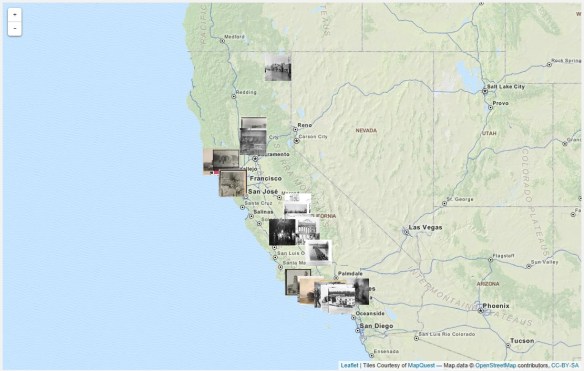
The homepage provides a brief synopsis of each major disaster type, along with resources for teachers, including class activities based on thematic collections of these images. Additionally the site includes a helpful document titled “How to Use Local History Mapped” and some complementary links from the Joint Committee on Geographic Education.
That reminds me of this book:

It’s very interesting with first hand accounts of California disasters from 1800 to 1900.
Found this posting on ranking the top 10 on-line GIS graduate programs:
 SoCalGIS.org