Unknown's avatar

About socalgovgis - Michael Carson

Michael Carson, GIS Manager (retired) for the City of Burbank and President of Southern California Government GIS User Group. Currently teaching GIS at College of the Canyons in Santa Clarita.

Finally: Tallest Building in LA Gets an Observation Deck … and Skyslide!

The US Bank Tower in downtown LA (formerly Library Tower and First Interstate Bank World Center) is a 73 story, 1,018 foot tall skyscraper at 633 West Fifth Street and is the tallest building west of the Mississippi River (11th tallest in the US).  The building was constructed from 1987 to completion in 1989.

For many years I wondered why the tallest building in downtown LA never had an observation deck.  It was a bummer not to have one, especially on our tallest building!  But finally in July 2014, the owners of the skyscraper announced construction of an observation deck on the 69th and 70th floors, a restaurant on the 71st floor, and a glass slide outside to slip from the 70th floor to the 69th!

It should all be ready for you to try out by mid-2016.  Check it out!

towerslide

And if you wait until 2017, the new 73 story Wilshire Grand being constructed now will have its own sky-high observation deck and restaurant, plus an infinity pool on the rooftop!

ESRI Goes Big With SGELA

ESRI has supersized their Small Government Enterprise License Agreement (SGELA) which now includes local governments serving populations up to 250,000.

With an ELA, you have access to ESRI’s core products (Desktop, Server, Engine, Runtime) and extensions, with as many installs of the software that you need.  You also get an ArcGIS Online account for your organization, Portal for ArcGIS, CityEngine, access to ESRI Developer Network (EDN), Virtual Campus dollars for web training, instructor-led training discounts, and User Conference passes.  All for a pretty reasonable price per year for 3 years.  For example, Tier 4 runs about $50,000 per year.  Get your SGELA today and start expanding your organization’s access to GIS services and products!

Leap Year 2016: Fun Facts!

Today is leap year day!  Every 4 years (well, almost … read on) we have an extra day in February (the 29th) added to the calendar.  For those that have wondered why, here are some interesting facts:

Why do we have leap years?

A leap year, where an extra day is added to the end of February every four years, is down to the solar system’s disparity with the Gregorian calendar. A complete orbit of the earth around the sun takes exactly 365.2422 days to complete, but the Gregorian calendar uses 365 days. So leap seconds, and leap years, are added as means of keeping our clocks (and calendars) in sync with the Earth and its seasons.

Julius Caesar vs. Pope Gregory

The Roman calendar used to have 355 days with an extra 22-day month every two years until Julius Caesar became emperor in the 1st Century and ordered his Alexandrian astronomer Sosigenes to devise something better. Sosigenes decided on a 365-day year with an extra day every four years to incorportate the extra hours, and so February 29th was born.

Why does the extra day fall in February?

All the other months in the Julian calendar have 30 or 31 days, but February lost out to the ego of Roman Emperor Caesar Augustus. Under his predecessor Julius Caesar, February had 30 days and the month named after him, July, had 31. August had only 29 days. When Caesar Augustus became Emperor he added two days to “his” month to make August the same as July. So February lost out to August in the battle of the extra days.

Refining the system about 500 years later

As an earth year is not exactly 365.25 days long, Pope Gregory XIII’s astronomers decided to lose three days every 400 years when they introduced the Gregorian calendar in 1582.

What about leap seconds?

Leap years are not directly connected to leap seconds, but both are for the purpose of keeping the earth’s rotations in line with our clocks and calendars. Leap seconds are added to bring the earth’s rotation into line with atomic time. A leap second was added at the end of June last year, when immediately before midnight dials read 11:59:60.

Atomic time is constant, but the Earth’s rotation is gradually slowing down by around two thousandths of a second per day. Leap seconds are therefore crucial to ensuring the time we use does not drift away from time based on the Earth’s spin. If left unchecked, this would eventually result in clocks showing the middle of the day occurring at night.

The extra second can sometimes cause problems for some networks which rely on exact timings. When a leap second was added in 2012 Mozilla, Reddit, Foursquare, Yelp, LinkedIn, and StumbleUpon all reported crashes and there were problems with the Linux operating system and programs written in Java.

A leap year isn’t every 4 years

The year 2000 was a leap year, but the years 1700, 1800 and 1900 were not. There’s a leap year every year that is divisible by four, except for years that are both divisible by 100 and not divisible by 400. The added rule about centuries (versus just every four years) was an additional fix to make up for the fact that an extra day every four years is too much of a correction.

So far the math has worked ever since but the system will need to be rethought in about 10,000 years’ time. Perhaps when robots take over they will think of something for us!

 

World Geocoder for ArcGIS

ESRI has released World Geocoder for ArcGIS. World Geocoder for ArcGIS enables users to securely map global addresses behind a firewall so that sensitive data is never exposed.

World Geocoder for ArcGIS has several key benefits for organizations in addition to protecting sensitive data. It includes an API that can be used to add geocoding capabilities to ArcGIS apps and custom apps. World Geocoder for ArcGIS has been designed to geocode addresses from multiple countries, using a single locator, for a flat, fixed price.  Licenses come in Basic (250 million geocodes per year), Standard (3 concurrent batch jobs), and Advanced (8 concurrent batch jobs) levels.

Homeland Infrastructure Foundation-Level Data

The Homeland Infrastructure Foundation-Level Data (HIFLD) website, HIFLD Open, provides National foundation-level geospatial data within the open public domain that can be useful to support community preparedness, resiliency, research, and more.

HIFLD Open represents the initial evolutionary first step to provide online access to HIFLD Data. HIFLD Open provides publicly available datasets previously contained in HSIP 2015. These 270+ public domain datasets consist of both re-hosted public domain data AND when possible, live pointers to dynamic web services direct from the source. Data is available for download in a variety of formats to include: CSV, KML, Shapefiles, as well as access to APIs – such as GeoJSON, and GeoService.

Please note that in alignment with a recent vote by members of the HIFLD Subcommittee, the release of this new data portal represents a new branding and packaging approach to the HIFLD product line. The legacy term ‘HSIP’ is now represented by Homeland Infrastructure Foundation-Level Data. For questions or additional information related to this announcement, please do not hesitate to contact the HIFLD Support Team at HIFLD@hq.dhs.gov.

Geocortex User Group Meeting March 22nd

Mark your calendars, the next Southern California Geocortex User Group Meeting will be held March 22, 2016 from 1-4pm at the City of Burbank.  The meeting room address will be:

Burbank Community Services Building
Conference Room 104
150 N 3rd St
Burbank, CA 91502

Coffee and refreshments will be provided.  Parking details soon.

Join fellow Geocortex users, administrators and partners for interactive discussions and presentations.

Tentative agenda:

  • What to expect from the upcoming releases of Geocortex Essentials 4.5, Geocortex Viewer for HTML5 2.6 and Geocortex Mobile App Framework 2.0. This release is packed with dozens of new features and effectively closes the feature gap with our Silverlight viewer.
  • A demonstration of the major improvements made to our mobile architecture; we’ve simplified the way clients deploy disconnected Geocortex applications for users in the field.
  • A Geocortex user presentation.

To attend, please register here.

Interactive Tours of New California National Monuments

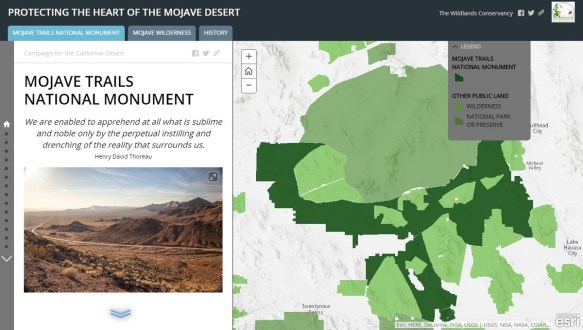
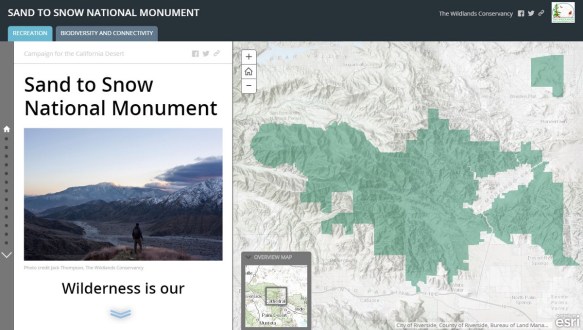
On February 12th three new areas were designated as national monuments in the California desert: Mojave Trails National Monument, Sand to Snow National Monument, and Castle Mountains National Monument.

Encompassing nearly 1.8 million acres of public lands, these new monuments are the culmination of decades of hard work and collaboration between government, conservation organizations, and local communities.

The Wildlands Conservancy played a major role in the creation of the Mojave Trails National Monument and Sand to Snow National Monument.  For the last 20 years they have acquired significant landscapes and saved them from development while stitching together California’s largest nature preserve system.

So you can better understand the new monuments, The Wildlands Conservancy has created two interactive tours of the Mojave Trails National Monument and Sand to Snow National Monument.  Check them out and go visit soon!

1on-zzint5foyuo4zaismbw

18qvjgjxwmnwnrxycfgxqtw

ArcGIS 10.4 Now Available

The ArcGIS 10.4 release is now available for all who have current licenses.  You can download the software from your my.esri.com account.

The new release includes new geoprocessing tools and updates, Python 2.7.10 with additional third-party libraries including SciPy, pandas, Sympy, and nose, and other updates to Mapping, Editing, Geodata/Geodatabases, and Network Analyst.  For more info, visit the 10.4 What’s New page.