The EPA has developed a new environmental justice mapping and screening tool called EJSCREEN. It is based on nationally consistent data and an approach that combines environmental and demographic indicators in maps and reports. Check it out.
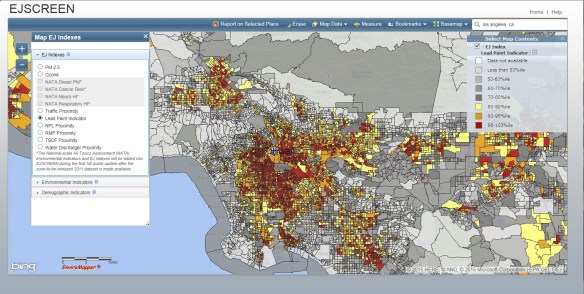


The EPA has developed a new environmental justice mapping and screening tool called EJSCREEN. It is based on nationally consistent data and an approach that combines environmental and demographic indicators in maps and reports. Check it out.
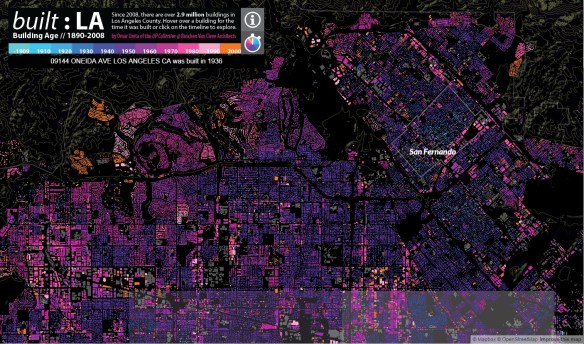
Inspired by previous building-ages maps that began popping up last year, urban designer Omar Ureta has created an interactive map of building ages in LA County. Ureta used the building outline data from LA County’s GIS data portal. You can click on the timeline to explore how the city has grown over time. You can also hover over a building to reveal the address and time it was built.
Yahoo has disclosed that it plans to shutdown its Yahoo Maps service at the end of June. The maps shutdown is part of their “spring cleanup of products”. Click below for more on the story.

The Web Soil Survey (WSS) provides soil data and information produced by the National Cooperative Soil Survey. It is operated by the USDA Natural Resources Conservation Service (NRCS) and provides access to the largest natural resource information system in the world.
NRCS has soil maps and data available online for more than 95 percent of the nation’s counties and anticipates having 100 percent in the near future. The site is updated and maintained online as the single authoritative source of soil survey information. Check it out.

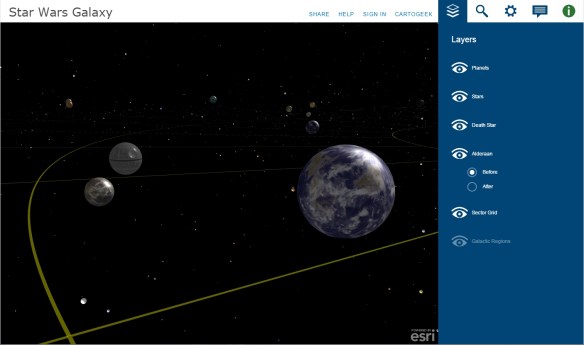
It was just a matter of time. ArcMap and CityEngine were used to build a Star Wars Galaxy interactive map. Check it out.
Are you a developer, firm, or organization using mobile or web applications to enable your users? The USGS has publicly available geospatial services and data to help your application development and enhancement.
The USGS National Geospatial Technical Operations Center will be hosting a 30- minute webinar on “Using The National Map services to enable your web and mobile mapping efforts” on June 16 at 9am Mountain Time.
Back in 1887, Fred Eaton, the City Surveyor, drew up plans for a proposed sewer system for the City of Los Angeles. He estimated a cost of $1,000,000 to construct the proposed system. A report from consulting engineer Rudolph Hering supported Eaton’s work and suggested spreading fields for the system.
I like how everything flows to one location, “Outfall Sewer”, at the lower left corner of the map. I wonder if some of that infrastructure is still there today? Check it out on the Huntington Digital Library site.

For you high-res junkies, here you go!
If you were a bicycling enthusiast back in 1896, you probably had this map on hand as you toured California. The map was surrounded by advertisements to make sure you had the latest bicycling gear. But more importantly the map outlined bike paths in red with labels which represented the road condition from good to very poor and the grade of the road from level to mountainous.
Check the map out on the Library of Congress site and download the high resolution image to see all the glorious detail!
The US Geological Survey (USGS) National Cooperative Geologic Mapping Program (NCGMP) in partnership with The Geological Society of America (GSA), GSA Foundation, Association of American State Geologists (AASG), American Geosciences Institute (AGI), American Institute of Professional Geologists (AIPG), and the Journal of Maps invites students to participate in the Best Student Geologic Map Competition.
This year marks the third annual Best Student Geologic Map Competition at the GSA Annual Meeting in Baltimore, Maryland. The competition will highlight student research from around the world that utilizes field mapping and the creation of geologic maps as a major component.
The top three student geologic maps will be selected for recognition and awards at a special judging session at the GSA Annual Meeting. Students will post their maps (Session Posters) on Tuesday, 3 November by 5:00 PM until 6:30 PM in the Poster Session area of the Exhibit Hall for review and evaluation by the judges. Maps may be placed in this area as early as 9 AM Tuesday, 3 November, but must be removed at 6:30 PM following the session. At the end of the session the top three maps will be selected and awarded.
Found this interesting startup which claims to have invented the “simplest way to communicate a location”. The startup, what3words, divides the world up into 57 trillion 3×3 meter squares and then assigns each with three words that makes them unique. With that, you now have a unique address for any location on the globe … even in the middle of nowhere!
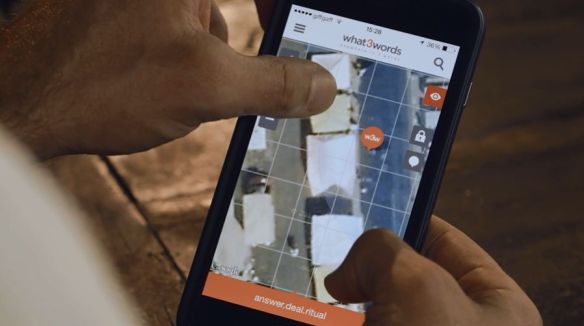
From a human standpoint this makes sense. We can remember three words for an address fairly easily, especially in a remote location that may not have an established address system. However, gridding the world is not new. We have many world grid systems, like MGRS that goes down to 1 meter squares.
Will what3words catch on? Who knows. Maybe if Amazon starts using it for deliveries by drone! Start telling your friends to meet you at “humans.flash.crab” after work!
 SoCalGIS.org