Road and Aviation Noise

While helping out someone that was looking for fatal accident data, I ran across a cool map service hosted by the US DOT Bureau of Transportation Statistics.  Looking at the REST endpoint for their map services, I found the National Transportation Noise Map.  The service description reads:

The National Transportation Noise Map is developed using a 24-hr equivalent sound level (LEQ, denoted by LAeq) noise metric. The results are A-weighted noise levels that represent the approximate average noise energy due to transportation noise sources over the 24 hour period at the defined receptors. This map includes simplified noise modeling and is intended for the tracking of trends, it should not be used to evaluate noise levels in individual locations and/or at specific times. https://maps.bts.dot.gov/noise/

If you click on the link in the description, it will take you to a document that outlines how the noise levels were collected and processed.  A few points about the data:

  • It is a simplified noise model to track trends
  • Flight operations are averaged into a single average annual day
  • Military operations were not included unless they were at a joint-use or commercial airport
  • Helicopter operations were not included
  • Flight track info was available for some airports for the modeling, and for the ones that did not have any flight track info, a straight-in and out procedure was modeled
  • For the road noise model, average annual daily traffic values were used in conjunction with vehicle types and speed, distributed evenly across 24 hours
  • The noise level cutoff of 35 db(A) was used

Adding the image service to ArcMap displayed this in the LA basin area:
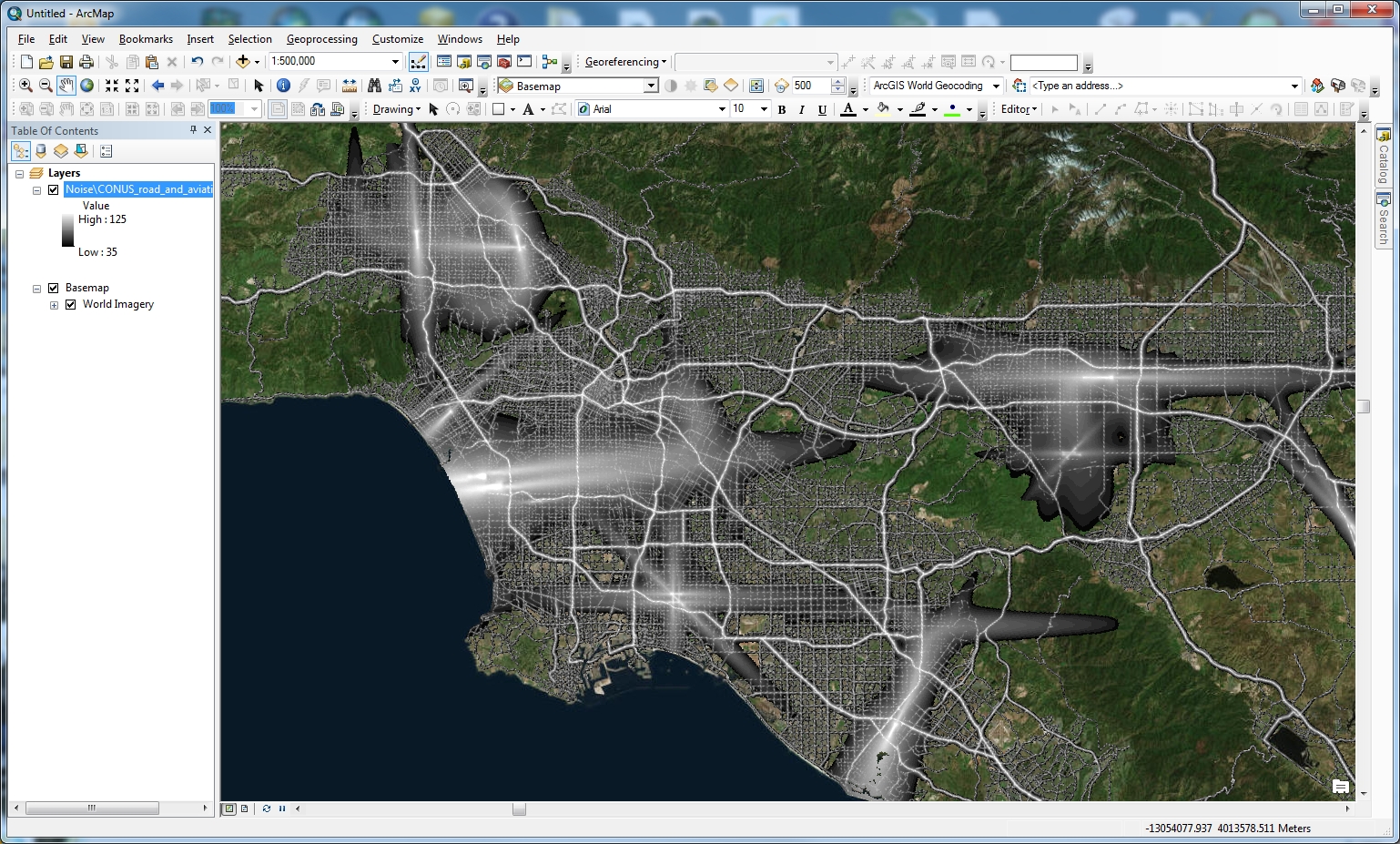
noise1

I then changed the color ramp so high noise levels were red and low noise levels were blue.

noise2

Pretty cool … unless you live near LAX!
ArcGIS Earth 1.7 Beta

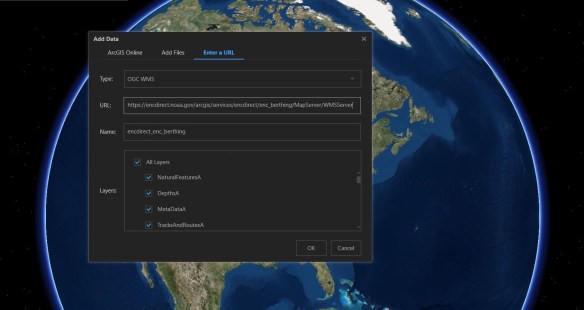
The ArcGIS Earth 1.7 Beta is now available.  In this release users can look forward to the ability to identify and display metadata and attribute information for map services, image services, and WMS services on the globe, a smoother navigation experience, improved rendering for KML, improved drawing elements, labeling in multiple languages, and a new startup experience for first time users. Additionally, administrators will have the ability to customize startup criteria to meet the needs of their organization.

Click below to find out more and how to sign up for beta testing.

wms1

Future Communities Forum

SCAG’s Future Communities Forum, a unique gathering of researchers, business and civic leaders, and policymakers from Southern California and around the world, will showcase how technology and open data are being used to solve common challenges.

The forum will be held Wednesday, May 2 from 11:30 a.m. to 4:30 p.m. at the Renaissance Indian Wells Resort & Spa.  Click below for more info and to register.

futurecommunitiesbanner01_1

How Americans Do Their Taxes

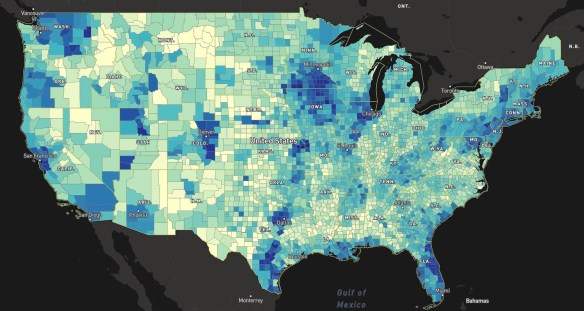
Who does your taxes?  H&R Block?  TurboTax?  A CPA/Tax Professional?  Yourself?  Check out this web map by ESRI.  ESRI says it used data at the census tract and block group level. It looked at whether taxpayers used H&R Block, TurboTax, a certified public accountant or other tax professional, or did their taxes on their own. ESRI then credited that block to which ever method was used the most.  Click on a point and get the breakdown of tax methods.

taxmap

Stuff in Space

January 2023 NOTE: The Stuff in Space website has moved.  The link to the site has been updated.

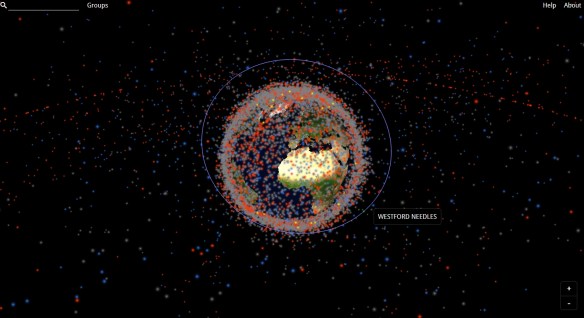
Stuff in Space is a “real-time 3D map of objects in earth’s orbit”, including satellites and debris. This map uses data from Space-Track.org, a website operated by the U.S. Department of Defense. On this map, different kinds of “stuff in space” are color-coded: red for satellites, blue for rocket bodies, and grey for debris. Visitors may also explore different groups of space objects, which include maps of all Global Positioning System (GPS) satellites and their orbits and a map of the debris created by the 2009 collision of the satellites Iridium 33 and Kosmos 2251.  Check it out!

stuffinspace

Cities at Night

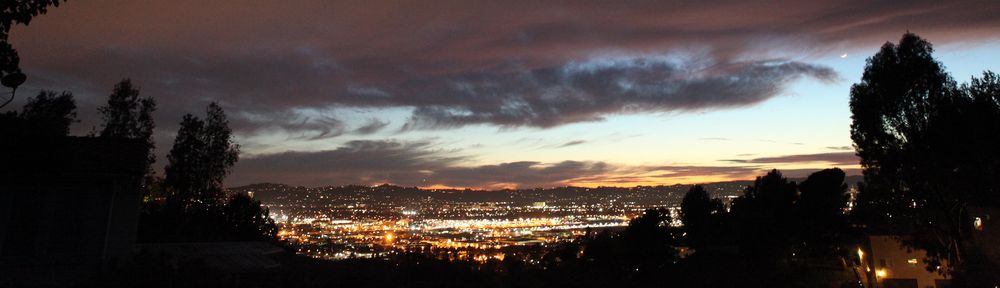
Astronauts on board the International Space Station (ISS) take hundreds of night-time pictures each year of cities around the globe. Cities at Night is a “citizen science project that aims to create a map, similar to Google maps, of the Earth at night using night-time color photographs taken by astronauts onboard the ISS.” Check out the photographs that have been geo-referenced to the Earth, or join in and help the project team geo-reference new photographs!

citiesatnight

Useless FCC Broadband Map

In February the FCC released their new broadband map showing the availability of high-speed internet in the US.  Many of you might remember their previous map which turned out to be completely useless.  Well … this new one seems to be about the same, not matching the reality on the ground.  Click below to read more about the story.

fcc-broadband

A great example of how to lie with maps.  Hey!  There’s a book about that!  You should get it, it’s a great book.

9780226435923-us

New LA County GIO

Congratulations to Steven Steinberg on becoming the new GIO at LA County!

Before joining the County, Steven was the Principal Scientist and Department Head for Information Management and Analysis at Southern California Coastal Water Research Project (SCCWRP) a public agency for environmental research located in Costa Mesa.

Steven has extensive experience with geospatial analysis technologies including GIS, remote sensing, and image analysis in interdisciplinary applications.  He has a B.S. in Natural Resources, a M.S. in Natural Resources Policy and Management, and a Ph.D. in Forestry (Geospatial Sciences).  He also has co-authored books, such as GIS Research Methods: Incorporating Spatial Perspectives (2015) and GIS for the Social Sciences: Investigating Space and Place (2006).

Send Your Name to the Sun

In celebration of the summer 2018 launch of the Parker Solar Probe, NASA is inviting the public to submit their names to be added to a microchip which will be placed onboard the spacecraft.

Read more about it on Geo Lounge (click image below), which also has a link to the site for you to register your name.  But hurry, you must submit your name by April 27, 2018!

spp_observingsun2_0