SoCalGIS Meeting September 16th

Well, it has been a while since our last meeting.  I think it’s time for one!

Our next SoCalGIS meeting will be hosted by CyberCity 3D.  They will be demonstrating their state-of-the-art 3D Geospatial Building Modeling and new 3D Streaming Maps services.  Check out their new website www.cybercity3d.com .

Lunch will be provided!  So come early and network during lunch before our meeting presentations.  Here is the agenda.

SoCalGIS Meeting September 16th
11:30am to about 2pm
Round Table Pizza
4330 Redondo Beach Blvd., Torrance

The meeting room is in the back of the restaurant.  Plenty of free parking and I believe there will be wifi available too.

If you plan on attending, please RSVP to me so I can get a head count.

Also, I am looking for others to present their work on anything GIS.  It would be nice to see what other cities or the county are doing.  Just let me know if you are interested in presenting.  Thanks!  -mike

Why Data Quality Matters

Not long ago, obtaining data for a GIS-based project was an arduous task. Because great time and effort was involved with either creating your own data or obtaining data that someone else created, you had to think carefully about the quality of the data that would go into your project. While it can still be cumbersome to obtain data at specific scales for specific areas, cloud-based data services, crowdsourced maps and databases and real-time streaming make it easy for anyone to obtain vast amounts of data in a short amount of time. In an environment where so much data is available, is data quality still of concern? Read more here.

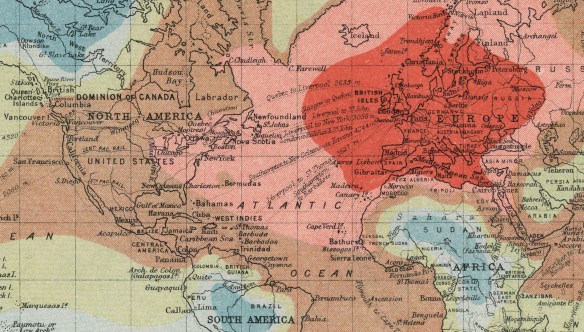
1906 Isochronic Distance Chart

Travel in the slower days of 1906!  Here is an interesting map using “isochronic” lines, specifically lines depicting points which may be reached in the same number of hours or days from London in 1906.  Need to go to New York?  That will be about 8 days of travel.  San Francisco?  That will be about 15 days.  Santiago, Chile?  You are looking at over 40 days of travel.

isochronicdistancechart1906

xx

Crowdsourced Remote Sensing

What do OpenStreetMap, National Map Corps, Wildebeest Watch, Frack Finder, PlanktonPortal, Galaxy Zoo, Disk Detective, Cyclone Center, SunSpotter, Map Give, and Geo-Wiki have in common?  They all use crowdsourced remote sensing for data collection, basically using people’s visual cognition skills which are better than machines to collect data from aerial and satellite images.  Check out the article here.