The Future of Programming: Wolfram Language

Stephen Wolfram has worked on the Wolfram Language for about 30 years now. The Wolfram Language is a knowledge based programming language. It’s a language with a vast amount of knowledge about how to do computations and it’s a language that has a model of the world built in. The symbolic nature of the language allows it to accommodate any style of programming. It can even use natural language. And it makes it really easy to create really powerful programs.

The goal of the Wolfram Language is to encapsulate as much computational knowledge as possible so people can go from ideas to deployed products as quickly and easily as possible. The Wolfram Language is a huge language, but it’s built on a small set of powerful principals:

  • Coherence – everything in the language must fit together.
  • Maximum Automation – the language should take care of as much as possible.
  • Symbolic Nature – allow the language to define and describe its own deployment.

You can run the Wolfram Language in the cloud and access it via mobile devices. You can take any Wolfram Language function and setup an instant API for it that you can call from anywhere on the web. For example, asking for a JSON output of some weather data for a user’s geo-location. The Wolfram Language can interact with connected devices using the Wolfram Data Framework (WDF).

And yes, the Wolfram Language has detailed maps of everywhere built in! This is the future of programming my friends! Check it out.

ESRI’s Small Government Departmental Platform Program

ESRI’s new Small Government Departmental Platform Agreement allows for unlimited deployments of core ArcGIS software within one governmental department. Departments that have plans to integrate GIS in multiple workflows, such as assessors, health and human services, public works, fire, and planning departments, can use this program to rapidly achieve their goals.

This program is ideal for departments that want to:

  • Increase ArcGIS software and Software as a Service (SaaS) deployments
  • Have flexibility when deploying GIS to desktops, servers, and mobile devices
  • Have a predictable annual licensing model

The Small Government Departmental Platform Agreement program is open to all governments in the United States with populations of 100,000 or less. For more information, call ESRI at 800-447-9778.

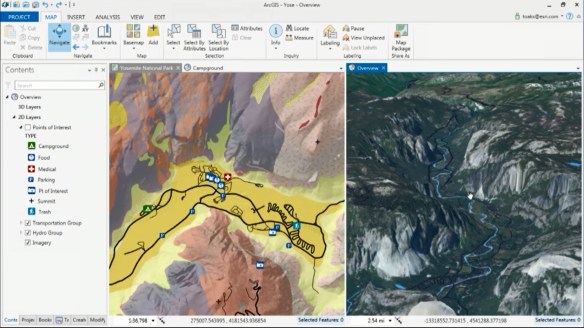
ArcGIS Pro … Soon

During the 2013 ESRI User Conference in San Diego, ESRI demonstrated what they called ArcGIS Professional.  It was still under development at the time, but they said it was slated for a Q4 2013 release.  That did not happen, though maybe it was for beta testing sites?  Not sure.

Now they are saying it will be part of the ArcGIS 10.3 release planned for the second half of 2014.  If you have not seen it yet, below is a video from the ESRI Federal GIS Conference in February 2014.

arcgispro

ArcGIS Pro has a ribbon interface that would be similar to Microsoft Excel and Word products.  I personally don’t like that type of interface, the functionality gets lost to me.  Others might find it natural though.

ArcGIS Pro is a 64-bit multi-threaded application that is designed to be the premier application for visualizing, editing, and performing analysis using your local content or content from your ArcGIS Online account or Portal for ArcGIS.  You can author content in both 2D and 3D and publish it as feature, map, and analysis services, 3D web scenes, and web maps.

ESRI states that ArcGIS Pro will not replace ArcGIS for Desktop.  Prediction: I give them 3 years before Desktop goes to live with ArcView 3.

The initial release will not have all the functionality that ArcGIS for Desktop has, but Pro will have capabilities that Desktop does not right now:

  • Project based workflows
  • Combined 2D/3D visualization
  • 64-bit support
  • Multiple layout support

Map documents (.mxd), scenes (.sxd), and globes (.3dd) can be imported into ArcGIS Pro and saved as projects (.aprx).  WHAT?  Having ArcView 3 flashbacks?!!!

ESRI did state that projects are not backward compatible so you cannot go back to ArcMap.  But keep in mind the geodatabases you use in Pro will also be accessible by ArcMap so there can be collaboration at the data level.  Services published with Pro can be shared with ArcMap.  Also, both can run side by side on the same machine.

ArcGIS Pro is part of ArcGIS for Desktop, so only ArcGIS for Desktop customers will be able to receive ArcGIS Pro.  ArcGIS Pro will come in three licensing versions that correspond to Desktop license levels Basic, Standard, and Advanced.  Also, the initial release of Pro will be able to work with the following Desktop extensions: 3D Analyst, Spatial Analyst, Network Analyst, Workflow Manager, and Data Reviewer.

ArcGIS Pro will run on Windows 7 or 8 on a 64-bit machine.  8GB of RAM or more is recommended.

There is no doubt that ArcGIS Pro will be featured at the ESRI Conference in San Diego this year!  Looking forward to it. -mike

Pacific Region Geospatial Data Announcements

From Drew Decker at USGS:

  • National Hydrography Dataset (NHD) releases Web HEM Tool.  HEM stands for Hydrography Event Management and is a tool developed to help relate users’ data to the NHD network as events.  Please see announcement on pages 4 and 5 in the latest NHD Newsletter here:  http://nhd.usgs.gov/newsletters/News_13_6_April.pdf
  • New urban imagery is now available for a number of California cities.  The datasets are natural color and have a one foot resolution.  The data cover the Fresno, Modesto, Oxnard, Stockton, and Sacramento urban areas.  Data can be downloaded through the EarthExplorer site: earthexplorer.usgs.gov (all cities) and The National Map Viewer site: nationalmap.gov/viewer (all except Modesto).

MapStory Webinar Opportunity

If you are interested, you are invited to the seventh webinar of the “Open Geospatial Science & Applications” webinar series on May 15th, 2014.  The webinar will be open and free to all on first come register basis.

This webinar will be on MapStory, the Atlas of Change that everyone can edit.  MapStory is a place to unify and improve our shared knowledge about global change.  Mapstory envision a world where everyone’s wisdom can be tapped, peer reviewed and organised into a non-commercial global data commons that helps us all improve our understanding of global dynamics, worldwide, over the course of history.  Details at http://mapstory.org .

This presentation will be by Dr. Christopher Tucker and is about the MapStory Foundation’s investment in the open source GeoNode, its use to enable crowdsourcing of open spatio-temporal data, and how people can use it to tell their stories to a global audience.  He will be talking about the GeoGit/GeoNode integration that is happening this Summer and how that will open participation widely to users who have as little as a single edit to contribute.

Attendees will be able to interact with the speakers by sending their comments and questions through chat.  All attendees of this web seminar will receive certificates for their participation.  To register visit https://www2.gotomeeting.com/register/922723730 .

The recording will be made available also later for the benefit of the wider community at http://mundogeo.com/webinar/opengeoscienceandapplications/ .

GIS Council Meeting May 22

Dear California GIS Community,

As many of you know, it has been a couple of years since the California GIS Council has met.  During the recent California GIS Conference (CalGIS) in Monterey, three coordination meetings were held and many people expressed a strong desire to revitalize the GIS Council. During these discussions representatives from county, regional, state and federal level GIS organizations validated that it remains in California’s best interest to have the GIS Council to help move forward with the California spatial data infrastructure.  In particular, the California Geographic Information Council (CGIA) expressed its commitment to support GIS Council activities.

Based on this input, eight of those in the earlier coordination meetings (including Carol Ostergren, Bruce Joffe, Robert Yohi, Mark Greninger, Christina Boggs, and me), scheduled a lunch meeting with GIO Scott Gregory at CalGIS.  During that discussion Scott agreed that the GIS Council can play an important role in shaping California’s GIS data framework.  He emphasized the importance of the Working Groups within the Council, and supports its new start.  Scott also stressed the importance of deliverables related to Working Group activities. He would like to have each group develop, if they have not already, a business plan regarding mission, goals, objectives, and deliverables. Scottwill hold an advisory role on the Council, and will work closely with the Council and commit his or his staff’s time to participate in all GIS Council meetings and activities.

The GIS Council Meeting will be held on Thursday, May 22 in Sacramento from 9am – noon. The address is 1325 J Street, 16th Floor, and it will be held in the Zinfandel Conference Room.

There are several agenda items for this meeting, including:

  1. Provide a brief history of the GIS Council, and discuss how it relates to the California State Government GIS User Group, the California State Government GIS Leadership Group, California URISA Chapters, and the California Geographic Information Association.
  2. Hold elections.  The previous Board has timed out, and we are seeking new leadership from the GIS Community. Scott wants to stress the importance of local participation. This has traditionally been a “State” dominated council. He wants to see more local government participation.
  3. Review existing Working Group progress and seek leadership on additional GIS Council Working Groups.  Each Working Group focuses on one of California’s framework data sets. Active Working Groups will provide reports at this meeting, and others will report out at the next meeting.
  4. Discuss and develop recommendation of top priorities for the GIS Council in the upcoming year and draft action plan.
  5. Agree on frequency of GIS Council meetings, and set future meeting dates for at least one year.

More details will follow in subsequent email messages. The purpose of this message is for you to save-the-date on your calendar and consider stepping up to a leadership role on the Council. The Council has broad representation from multiple sectors, and there are many opportunities for participation!

If you would like further information or have any questions about the GIS Council and plans to move forward, please contact one of the following people:

In collaboration with the California Strategic Growth Council (SGC), I will be working with the GIS Council leadership to develop meeting agendas, communicate with the SGC and GIO about funding needs and opportunities, and facilitating the GIS Council meetings.

Please stay tuned for more messages about the GIS Council meeting on May 22nd.

Sincerely,

Karen Beardsley

Karen Beardsley, PhD, GISP
Managing Director, Information Center for the Environment (ICE)
Department of Environmental Science and Policy
One Shields Avenue
University of California
Davis, CA  95616
Ph: (530) 752-5678
Fax: (530) 752-3350
Cell: (530) 848-3310
kbeardsley@ucdavis.edu

Spatial@UCSB 2014

The University of California, Santa Barbara will once again be hosting their annual Spatial@UCSB on June 3, 2014 at UCSB for the 7th year. The meeting will allow an opportunity for local GIS practitioners to interact with GIS students and exchange ideas and insights in an academic setting.

For more information and details visit the Spatial@UCSB website.

EPA Map of California Tracks Pollution

The California Environmental Protection Agency has released a statewide list of census tracts most burdened by pollution. Many of the worst pollution pockets identified are in the San Joaquin Valley, Los Angeles County and the Inland Empire.

The screening tool, called CalEnviroScreen, was developed by the Office of Environmental Health Hazard Assessment, a branch of Cal/EPA, to pinpoint the communities with the highest exposure and vulnerability to multiple environmental hazards, including polluted air and water, waste facilities and contaminated soil.  The rankings, however, are not based only on measures of environmental exposure. They also take into account socioeconomic characteristics and health data on residents to assess the overall vulnerability of communities. Those factors include poverty, education, unemployment, rates of asthma and low-birth-weight infants.

You can read more about it in this LA Times article.

epapolutionapp

As a side note, I find the CalEPA app a little slow in Internet Explorer.  Google Chrome was a little faster.  They are using ArcGIS Online technology for their mapping.  If you do a search for “calenviroscreen” on ArcGIS.com, you will see a listing of their maps and apps for versions 1.1 and 2.0.

ArcGIS 10.2.2 Now Available

ArcGIS 10.2.2 is now available for download from the Esri Customer Care website.  ArcGIS 10.2.2 is a minor incremental release focused on software fixes and quality.  Issues that have been fixed are listed here.

Also, if you use an Oracle geodatabase, there is a required patch you need to install with your 10.2.2 software.

Install guides: Desktop and Server (Windows or Linux).

Indian Ocean Images on Google Maps

An eagle eyed reader pointed this out to me today.  If you look on Google Maps in the Indian Ocean, you will notice a patchwork of what appears to be recent satellite photos.


Thanks goes to Tim Harvey for pointing this out.

This might be related to the search of flight MH370, however I could not find any articles about it.  If any of you know, please reply to this post and give us all the details.