World Geocoder for ArcGIS

ESRI has released World Geocoder for ArcGIS. World Geocoder for ArcGIS enables users to securely map global addresses behind a firewall so that sensitive data is never exposed.

World Geocoder for ArcGIS has several key benefits for organizations in addition to protecting sensitive data. It includes an API that can be used to add geocoding capabilities to ArcGIS apps and custom apps. World Geocoder for ArcGIS has been designed to geocode addresses from multiple countries, using a single locator, for a flat, fixed price.  Licenses come in Basic (250 million geocodes per year), Standard (3 concurrent batch jobs), and Advanced (8 concurrent batch jobs) levels.
Homeland Infrastructure Foundation-Level Data

The Homeland Infrastructure Foundation-Level Data (HIFLD) website, HIFLD Open, provides National foundation-level geospatial data within the open public domain that can be useful to support community preparedness, resiliency, research, and more.

HIFLD Open represents the initial evolutionary first step to provide online access to HIFLD Data. HIFLD Open provides publicly available datasets previously contained in HSIP 2015. These 270+ public domain datasets consist of both re-hosted public domain data AND when possible, live pointers to dynamic web services direct from the source. Data is available for download in a variety of formats to include: CSV, KML, Shapefiles, as well as access to APIs – such as GeoJSON, and GeoService.

Please note that in alignment with a recent vote by members of the HIFLD Subcommittee, the release of this new data portal represents a new branding and packaging approach to the HIFLD product line. The legacy term ‘HSIP’ is now represented by Homeland Infrastructure Foundation-Level Data. For questions or additional information related to this announcement, please do not hesitate to contact the HIFLD Support Team at HIFLD@hq.dhs.gov.

Geocortex User Group Meeting March 22nd

Mark your calendars, the next Southern California Geocortex User Group Meeting will be held March 22, 2016 from 1-4pm at the City of Burbank.  The meeting room address will be:

Burbank Community Services Building
Conference Room 104
150 N 3rd St
Burbank, CA 91502

Coffee and refreshments will be provided.  Parking details soon.

Join fellow Geocortex users, administrators and partners for interactive discussions and presentations.

Tentative agenda:

  • What to expect from the upcoming releases of Geocortex Essentials 4.5, Geocortex Viewer for HTML5 2.6 and Geocortex Mobile App Framework 2.0. This release is packed with dozens of new features and effectively closes the feature gap with our Silverlight viewer.
  • A demonstration of the major improvements made to our mobile architecture; we’ve simplified the way clients deploy disconnected Geocortex applications for users in the field.
  • A Geocortex user presentation.

To attend, please register here.

Interactive Tours of New California National Monuments

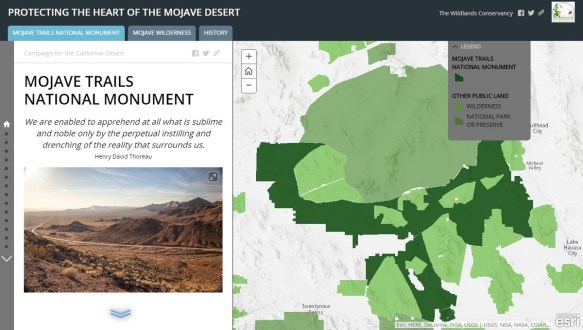
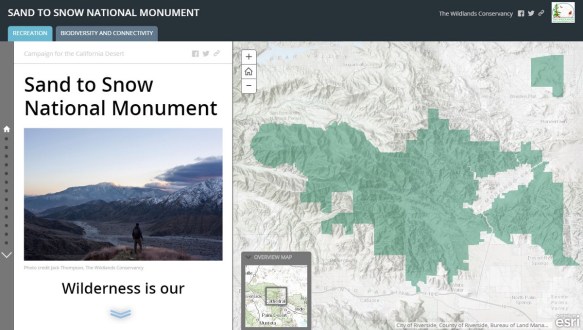
On February 12th three new areas were designated as national monuments in the California desert: Mojave Trails National Monument, Sand to Snow National Monument, and Castle Mountains National Monument.

Encompassing nearly 1.8 million acres of public lands, these new monuments are the culmination of decades of hard work and collaboration between government, conservation organizations, and local communities.

The Wildlands Conservancy played a major role in the creation of the Mojave Trails National Monument and Sand to Snow National Monument.  For the last 20 years they have acquired significant landscapes and saved them from development while stitching together California’s largest nature preserve system.

So you can better understand the new monuments, The Wildlands Conservancy has created two interactive tours of the Mojave Trails National Monument and Sand to Snow National Monument.  Check them out and go visit soon!

1on-zzint5foyuo4zaismbw

18qvjgjxwmnwnrxycfgxqtw

ArcGIS 10.4 Now Available

The ArcGIS 10.4 release is now available for all who have current licenses.  You can download the software from your my.esri.com account.

The new release includes new geoprocessing tools and updates, Python 2.7.10 with additional third-party libraries including SciPy, pandas, Sympy, and nose, and other updates to Mapping, Editing, Geodata/Geodatabases, and Network Analyst.  For more info, visit the 10.4 What’s New page.

PostgreSQL Client Libraries for ArcGIS 10.3

After installing a PostgreSQL database to be used by our 10.3 version of ArcGIS Server and Desktop, I was looking for the PostgreSQL client libraries to install on my Windows machine.  And guess what?  There were none!

In the installs I could see the usual ones for Oracle and SQL Server, but nothing for PostgreSQL for Windows.  How am I going to use ArcCatalog to create a new Enterprise Geodatabase in PostgreSQL?

Digging around on the internet revealed that it was not needed anymore.  As explained in the ArcGIS 10.3 documentation, ArcGIS 10.3 Desktop, Server, and Engine now contain the necessary PostgreSQL client libraries.  You can now connect directly from ArcCatalog to a PostgreSQL database from ArcGIS 10.3 without having to install those pesky client libraries!

Think about that for a moment.  If you have to install ArcGIS Desktop on a bunch of user workstations, you don’t have to install the PostgreSQL client libraries as well.  It will just work.  That saves a lot of time for sure.

And think about this one … if ESRI is making sure PostgreSQL databases will work out of the ArcGIS box, what direction are they leaning toward for future Enterprise Geodatabase implementation?  They did not choose Oracle or SQL Server.  Think about that.


The Changing Geospatial Landscape

The National Geospatial Advisory Committee released a report in December 2015 titled “The Changing Geospatial Landscape: A Second Look.”

The report states:

In this document, the committee contributes its perceptions of incipient technologies that we expect will guide, define or determine the development of this industry in the near and medium term. Of even greater importance, the report highlights those aspects of innovation that bear directly on public policy and on individual privacy and security. The NGAC has also prepared this report to help inform the development of the next iteration of the strategic plan for the National Spatial Data Infrastructure (NSDI) and the development of transition recommendations for the next Presidential administration.

You can view the report here.

GIS at Rio Hondo College

Spring semester starts first week in February at Rio Hondo College.  Course offerings can be located here: http://riohondo.isteaching.com/spring-semester-2016.html

Given a majority of our students are working, our courses are conveniently scheduled in late afternoon & evenings.  We also work closely with our civil and engineering course schedule (CAD required component of the GIS Certificate).  Rio Hondo College is located near the intersection of the 605 & 60 freeways.  We also have a class at the LA County DPW office in Alhambra.

We have a step by step process for applying for admission and registering for classes:  http://riohondo.isteaching.com/join-us/ .  New students can perform the steps entirely online.  Most classes are 4 units and last checked @46/unit.  Sign up today!

Warren Roberts GISP MLA
http://riohondo.isteaching.com/