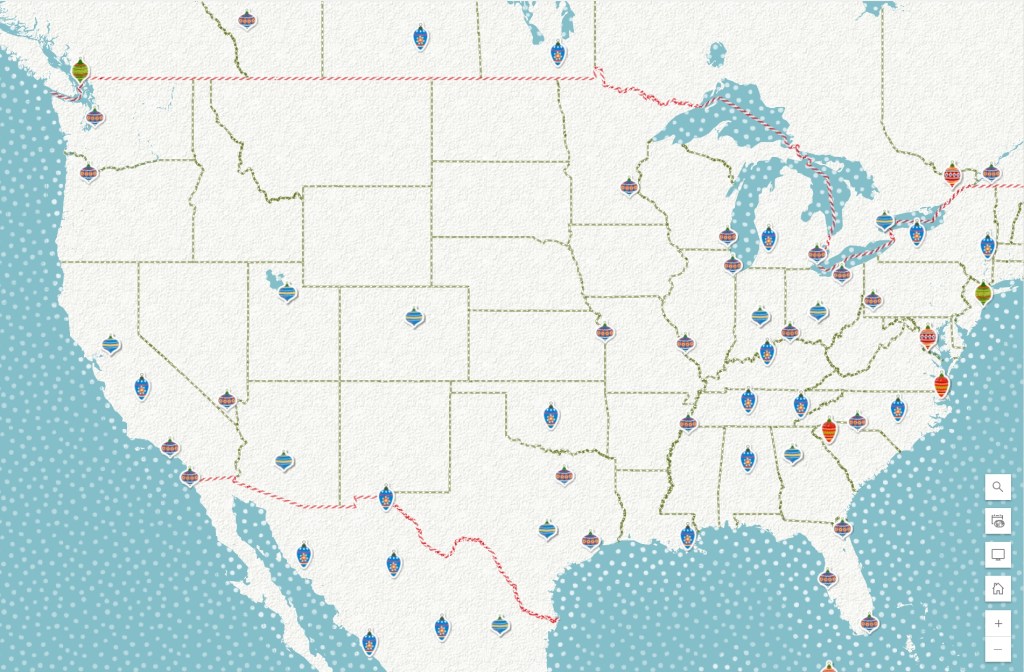
I wanted to say Merry Christmas to all and share the Merry Christmas Map (v2) from ESRI. The web map provides a detailed basemap for the world symbolized with a unique twist on the Christmas holiday. Check it out!

The next Cambridge Seminar in the History of Cartography will be held via Zoom on Tuesday 18 November 2025 at 5.30pm UK time (9:30am PST).
The speaker will be Chris Lukinbeal, University of Arizona on Cinematic Cartography.
All are welcome.
Please register for the talk at https://buytickets.at/emmanuelcollege/1929457 and the Zoom link will be sent to you.
**********
On a side note, this reminds me of a book I purchased a while back, Cinemaps. You should pick one up for a Christmas gift! -mike

On August 6th at 10:00 AM Pacific Time, USGS will host an informational webinar to provide an overview of the Fiscal Year 2026 (FY26) 3D National Topography Model (3DNTM) Data Collaboration Announcement (DCA) for the 3D Hydrography Program | U.S. Geological Survey (3DEP) and the 3D Hydrography Program (3DHP).
For more info and to register, click here.
Fireworks! Fireworks! Fireworks!
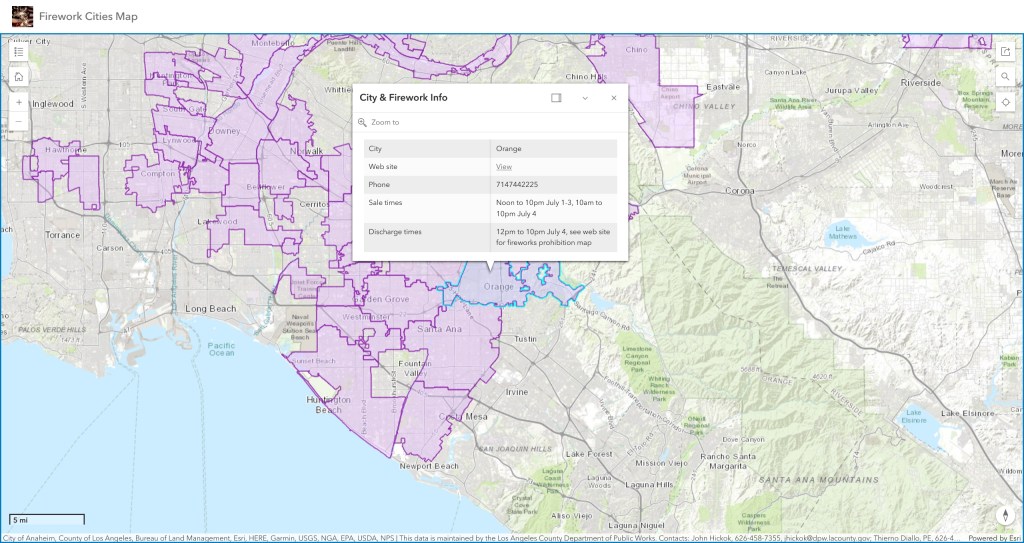
Yes, it is almost July 4th again and our famous SoCal Fireworks app has been updated for 2025.
For this year the City of Orange has joined the other cities that allow fireworks. Sadly the City of Carson and City of Inglewood decided to ban fireworks for this year.
Use the app to view cities that allow the sale and discharge of fireworks in LA, Orange, Ventura, Riverside, and San Bernardino counties. Included are days and times when fireworks will be sold and when you can light them up, as well as links to city websites and telephone numbers. Data was collected from municipal codes, websites, and/or contacting each city. Data provided as is. Some cities are allowing sales now. Check it out and be safe!

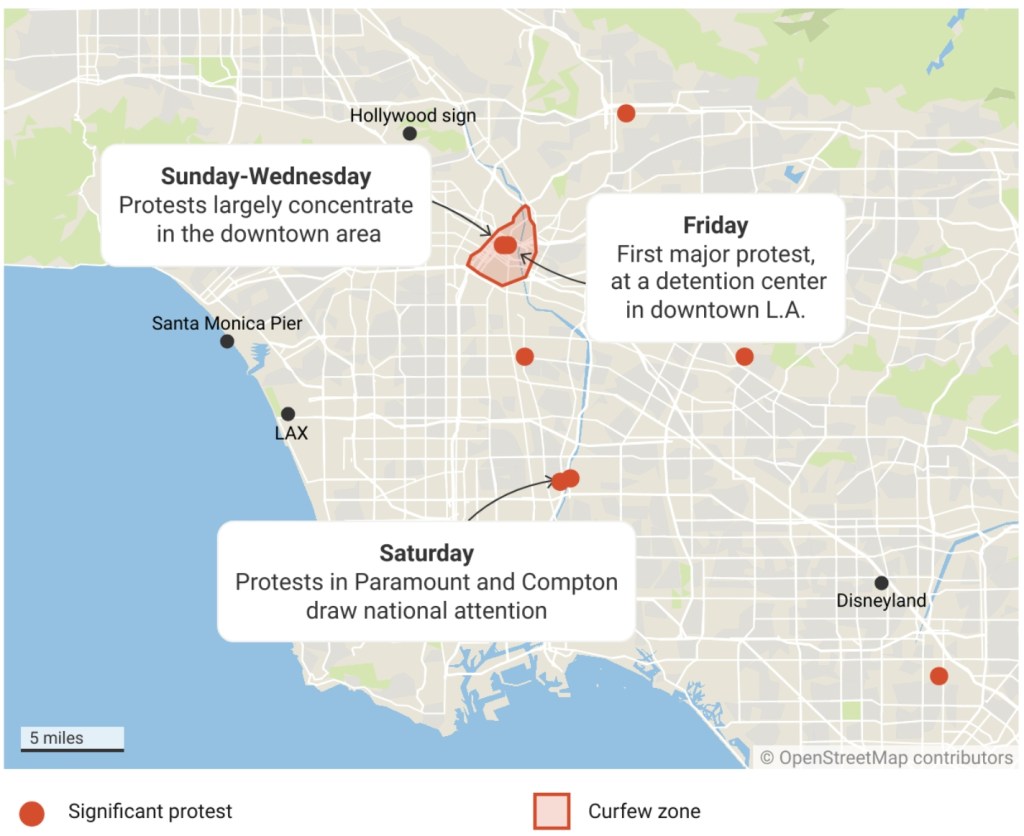
Is LA really under siege with all these riots? This article and map shows it really is not.

Los Angeles is a sprawling metropolitan area that’s home to nearly 13 million people. Unlike a lot of big cities, it doesn’t have one main population center. Angelenos are much more spread out than New Yorkers or Chicagoans. Most of the protests this week have taken place in a radius of just a few blocks of downtown L.A., where City Hall, LAPD headquarters and a federal detention center are clustered together.
The Library of Congress will have a webinar tomorrow on Maps of World War II. Register here: https://loc.zoomgov.com/webinar/register/8717489749718/WN_-3eNMamQR1y7mybLbU1d5Q#/registration
Reference librarians will give a brief overview of maps and other cartographic items from World War II that can be found in the Geography and Map collections at the Library of Congress. This session will highlight items made by American forces, as well as captured maps made by the Axis powers. The breadth and content of these items and how they came to the Geography and Map Division will be discussed. Participants will learn how to search for and access them online or in person. The focus of the session will be on maps and online resources available to all patrons any time or place in the world, but attendees will also learn how to prepare for a future trip to the reading room. After the presentation, staff look forward to answering additional questions from attendees.
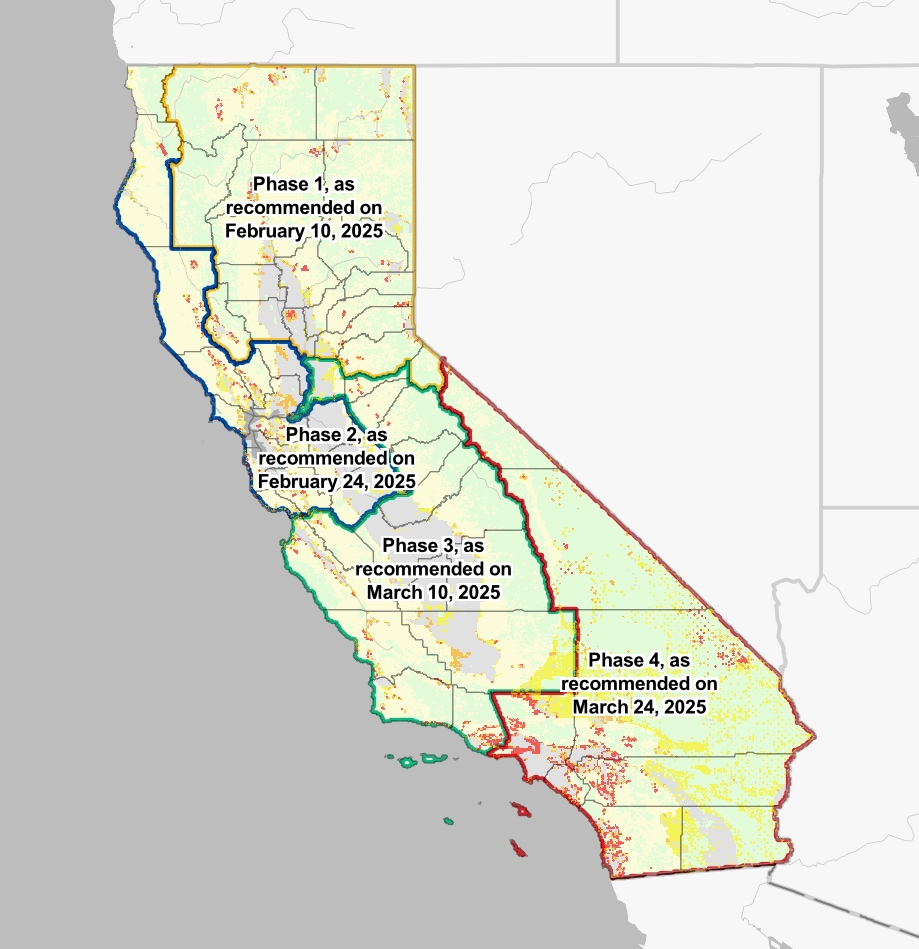
Cal Fire has released new Fire Hazard Severity Zone Maps. The maps for most of Southern California, as well as a large portion of rural eastern California, including Inyo and Mono counties, were released today as part of Cal Fire’s Phase 4 of Local Responsibility Area data. The first three phases encompassed the rest of the state, including Ventura County in Phase 3. Click below to check it out.

Some of you might not be happy since your property might have been moved into the high risk areas which might make your insurance go up … or be dropped! Visit the comparison viewer here.
The 2025 LA Geospatial Summit will be this Friday, February 28th, at the USC Hotel. For more info and to register, visit https://dornsife.usc.edu/spatial/los-angeles-geospatial-summit-2025/ .
Check out this fire app built with ArcGIS Online, Experience Builder, and publicly available data.

It combines CAL FIRE’s Damage Inspection (DINS) layers, Maxar imagery from NOAA & OpenAerialMap, dynamic charts that summarize DINS totals, historic structures in the Palisades area from Historic Places LA, and a link in the damage points pop-up to pre-fire Google Street View imagery.
More from the builder of the app here.