My original post had a link to the Seattle Times map showing the Washington landslide that occurred on March 22, 2014. ESRI has also released a map application of the landslide. It allows you to compare pre and post event imagery using a slider.
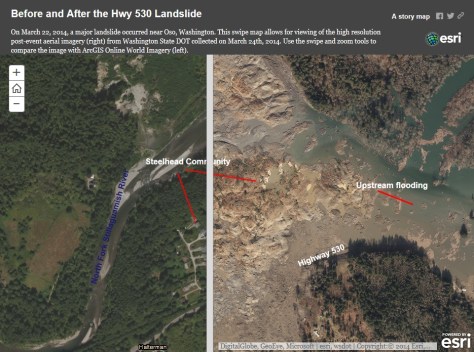

My original post had a link to the Seattle Times map showing the Washington landslide that occurred on March 22, 2014. ESRI has also released a map application of the landslide. It allows you to compare pre and post event imagery using a slider.
Just released, the latest edition of the nation’s most comprehensive look at land-surface conditions from coast to coast shows the extent of land cover types from forests to urban areas. The National Land Cover Database (NLCD 2011) is made available to the public by the U.S. Geological Survey and partners.
Dividing the lower 48 states into 9 billion geographic cells, the massive database provides consistent information about land conditions at regional to nationwide scales. Collected in repeated five-year cycles, NLCD data is used by resource managers and decision-makers to conduct ecosystem studies, determine spatial patterns of biodiversity, trace indications of climate change, and develop best practices in land management. Click below to check it out.

This came through in one of the email lists I’m subscribed to. I thought the articles were interesting on the importance of Open GIS and studies/research in academia. I know we in goverment GIS appreciate and reap the benefits of Open GIS standards and software solutions. Here is the posting (note the AAG conference starts tomorrow in Tampa, Florida):
Dear Colleague, As some of you know, there is pre-AAG workshop on "Open GIS: New Opportunities for Research and Education" on Monday (7th April) that Prof. Sergio Rey (Arizona State University) and Prof. Daniel Sui (Ohio State University) are organising. The primary goal of this workshop is to bring together researchers from academia, industry, and government agencies to discuss the new opportunities and set the agenda for Open GIS research and education in light of new advances during the past five years. An edited volume is planned based upon the talks given at this workshop. The two background papers for the AAG meeting which might be of interest to you: Open Regional Science by Sergio J. Rey (article here) Opportunities and Impediments for Open GIS,Transactions in GIS Volume 18, Issue 1, pages 124, February 2014 http://onlinelibrary.wiley.com/doi/10.1111/tgis.12075/abstract It is only rarely fundamental changes happen in a discipline and OpenGIS is the fundamental change that has happened in Geospatial Science. The pace of change has been much beyond our expectations and I thank all universities who have already established and those in the process of establishing Open Source Geospatial Labs and all our colleagues in "Geo for All" initiative. Our aim is to empower staff and students worldwide by using Free and Open Source GIS for education. What is the point of teaching GIS to students (in both developed and developing countries) and taking away the tools from them after the course and telling them that now you need to buy these expensive proprietary software licences if you want to continue using them after their course (which is what the proprietary GIS vendors would like !) I am determined to do everything in my abilities to make sure we can keep the windows of opportunities open for geospatial education for all students worldwide and for our future generations. I am looking forward to work with you on this. Best wishes, Suchith Anand University of Nottingham
By now everyone has probably seen the changes to Google maps. Some like the new look, while others find it too difficult to get used to. This article discusses some of the changes and why they were made.

Stanford University Libraries digitized William Smith’s Stratified Map of England, Scotland and Wales from 1815. It is part of an ongoing project to digitize thier “large map” holdings. Although the main section of the map is split into 15 pieces, when assembled, it measures approximately 8′ x 6′. The digital version is made up of 253 shots and is the largest item they have digitized so far. A high resolution composite of all parts would yield an image file approximately 12Gb in size.

Looks like there is a bug in ArcGIS Desktop 10.2 where ArcMap will crash when attempting to open certain shapefiles. You can download the patch here.
A total lunar eclipse on April 15th marks the beginning of a remarkable series of eclipses all visible from North America. For more info, visit the NASA site here.
When you mail in your tax forms that night on April 15th, you can watch the lunar eclipse too … or is that some kind of sign?
Greatest eclipse times in PDT:
April 15, 2014 – 12:47am
October 8, 2014 – 3:54am
April 4, 2015 – 5:00am
September 28, 2015 – 7:47pm
Mark your calendars! Our next SoCalGIS meeting will be held in conjuction with the LA Regional GIS Forum because our guest speaker will be Scott Gregory, the California State GIO. After the meeting there will be a Geospatial LA social. Right now it looks like the meeting will be hosted by LA County Public Works in Alhambra from 1 to 5 pm. More info and agenda soon!
 SoCalGIS.org